This article includes AI generated content (text, images) obtained with Pressnaut. All content has been fact-checked and manually revised by an human editor.
Pisa gets treated like a photo stop. People arrive on a coach, tilt sideways for the camera, buy a fridge magnet from a stall that sends nothing back into the neighbourhood, and leave. The city wears it. If you’re staying in Lucca, you have a better option: treat Pisa as a half-day walk through a working university town that happens to own the most famous bell tower on earth, and be back inside Lucca’s walls before the aperitivo hour.
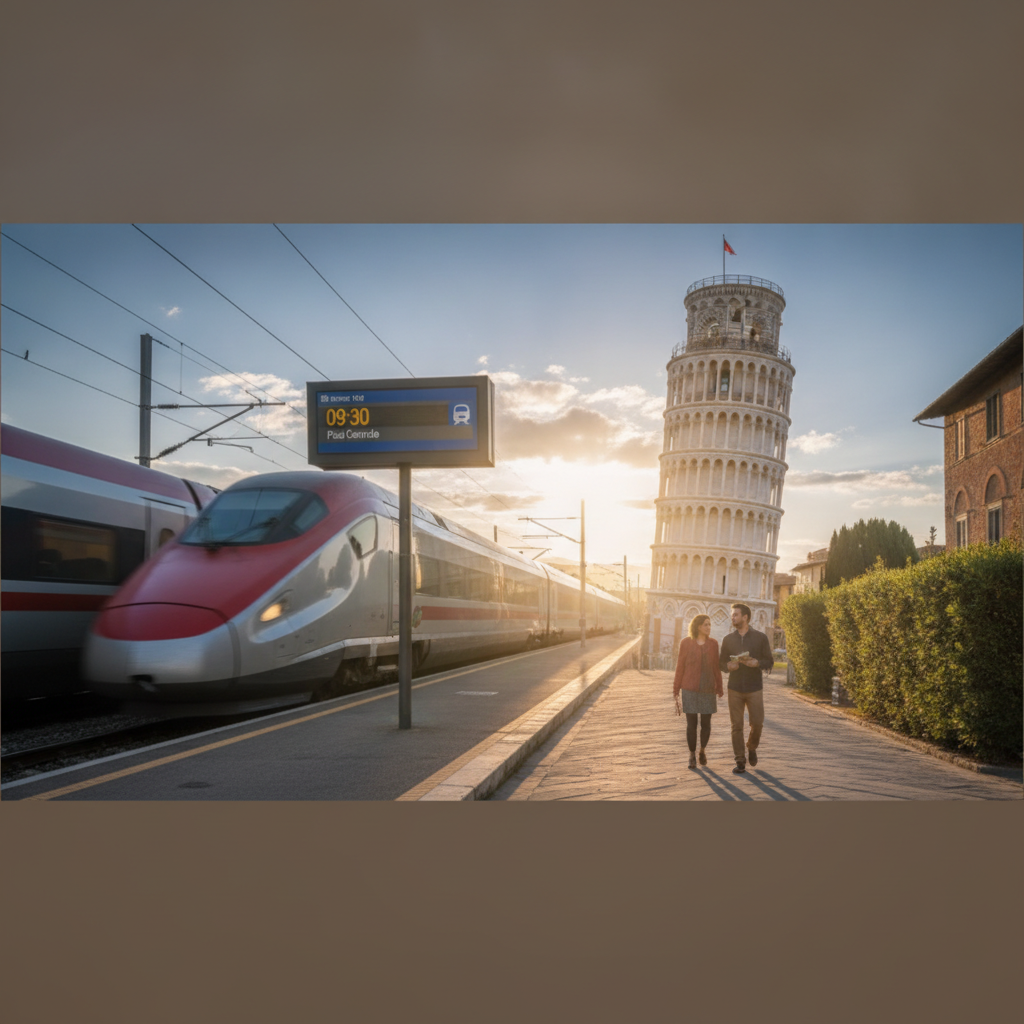
The two cities sit about 30 km apart, which is closer than most itineraries assume. ItaliaRail puts it at roughly 12 miles and calls the line one of the most heavily frequented local corridors in Tuscany. That word matters: local. This is a commuter route. Students, hospital staff, people going to see their mum. You’re borrowing a train that exists for residents, which is the cheapest and lowest-impact way to move between two Tuscan cities you’ll ever find.
The character gap is real. As one practical guide to the corridor puts it, Pisa is known for its Leaning Tower, bustling squares and busy station; Lucca for its intact city walls. Pisa carries an enormous visitor load in a very small piazza. Lucca absorbs people across a whole walled town. So do the arithmetic: give Pisa the morning, when the crowd is thinnest and the monuments are open, and give the slow hours to the place that can hold you comfortably.
Unless you’re climbing the Tower and taking your time with the museums, you do not need a full day. Half a day, honestly spent, is enough to see Piazza dei Miracoli and still meet the ordinary city behind it. If you’re still working out where to sleep, basing yourself in Lucca makes this whole trip simpler.
Direct regional trains do it in under 30 minutes. Trainline’s data gives an average of around 46 minutes across all services (that average includes the slower, change-of-train options), with around 34 trains a day. Thirty-four. You will almost never wait long, and you never need to lock yourself into a rigid plan.
Fares start from about $4.46 one way according to Virail, roughly five euro-ish depending on the day. These are regional tickets, no seat reservation, no advance-purchase penalty. Railclick is another search option if you like comparing before you commit, but honestly, buying at Lucca station on the morning is fine.
Pisa Centrale is the main hub, and it’s where you want to land if you’re doing the full walk I describe below. Pisa San Rossore is the small stop nearest Piazza dei Miracoli — useful if you have mobility limits, tired kids, or heavy rain. Not every service calls there, so check.
Paper tickets bought at a machine need validating before you board — the little green-and-white boxes on the platform. Digital tickets get scanned on the train. Get this wrong and the conductor will fine you, and they will not be moved by your accent.
The bus earns its place if you’re hauling luggage or connecting to Pisa airport, where the coach drops closer to the terminal than the train logic suggests. The same Lucca–Pisa guide lays out train, bus and taxi side by side; a taxi or private driver buys you flexibility at maybe fifteen to twenty times the train fare, which is a fair trade only if you’re a group of four with an early flight.
Driving, I’d skip. Pisa’s centre is a ZTL — restricted traffic zone, camera-enforced, fines arriving at your home address months later. You’d park on the periphery and walk anyway.
As for packaged Pisa-and-Lucca tours out of Florence: they lose enormous time to transfers. GoWithGuide names the “Pisa walking trap” — 25 minutes from Pisa Centrale to the monuments and 25 back — which on a coach schedule is dead time. Doing it yourself from Lucca, that same walk becomes the best part of the morning. And your five euro goes to the regional rail operator rather than a booking platform’s margin.
Book the Tower climb slot in advance and build everything else around it. The climb is timed entry with hard capacity limits — a genuine access limit on a fragile structure, and one of the few crowd controls in Italy that actually functions. Slots sell out in high season.
The climb itself takes about half an hour all up: roughly 300 worn marble steps, no bags allowed (there’s a free left-luggage point), and a minimum age of eight, with under-18s needing an adult. The lean is genuinely disorienting on the way up. It’s not for everyone, and skipping it is not a failure.
Combined tickets cover the Duomo, the Baptistery, the Camposanto and the museums, and they’re worth it. The Baptistery’s acoustics — a custodian demonstrates the echo hourly — and the Camposanto’s restored frescoes are, to my mind, better than the Tower. Nextstop Italy is right that Pisa has a plethora of beautiful structures; the Tower just hogs the attention. Earth Trekkers’ day-trip breakdown is a useful sanity check on time budgets.
Arrive early. Nine in the morning, the marble takes the light and the selfie scrum hasn’t formed. If the Romanesque striping gets under your skin, Lucca’s own Romanesque churches are the same architectural family, minus the queues.
Here’s the part that makes the trip worth writing about. Leave Pisa Centrale on foot and, two minutes from the station on the wall of Sant’Antonio, you’ll find Tuttomondo — Keith Haring’s last public mural, painted in 1989. Thirty figures, no fence, no ticket. A five-minute detour that reframes the city as somewhere people actually live and make things.
From there, cross the Arno and walk the lungarni, the riverside streets. Pisa’s position on the river gives you the best photographs in town, and almost nobody in the piazza has bothered. Tiny Santa Maria della Spina sits right on the bank, a Gothic reliquary chapel the size of a garden shed.
Then Borgo Stretto: arcaded, medieval, full of students and bookshops and bars that serve locals at local prices. Duck into Piazza delle Vettovaglie, the old market square, where produce stalls run in the morning and the eating and drinking picks up later. Piazza dei Cavalieri, Vasari’s civic set-piece and home to the Scuola Normale, is a two-minute step off the route.
Spend your money here rather than at the Tower stalls. Family-run bars, market traders, the cichetteria on the river — that’s where a euro stays in Pisa.
Rainy day? Weight the itinerary toward the Camposanto, the Museo dell’Opera and the arcades of Borgo Stretto, which are covered end to end. If you’re travelling with kids, get off at Pisa San Rossore, cut the walking in half, and treat the mural as the reward on the way back.
You’ll be back inside Lucca’s intact walls by two. Hire a bike or just walk the tree-lined loop on top of the ramparts — four kilometres of plane and holm oak, maintained by the city as public green space rather than a paid attraction. It’s the best decompression I know after a morning of marble.
Then the good part. Lucca’s wine bars and Colline Lucchesi DOC pours come from hills you can see from the walls — short supply chains, small growers, the opposite of the Tower gift shop economy. If your visit lands in late October, check the Lucca Comics & Games dates and shift everything earlier; the town fills completely and the trains fill with it.
Ending in Lucca beats ending in Pisa. Not because Pisa is lesser, but because Pisa’s centre of gravity is a single square built to be looked at, and Lucca’s is a town built to be lived in. Leave one before it tires of you. Stay in the other.
Roughly 30 km — about 12 miles.
Direct regional services run in under 30 minutes; the all-services average is around 46 minutes. Fares start from about $4.46 one way.
Yes, if you plan the walk. Four hours covers Piazza dei Miracoli, Tuttomondo, Borgo Stretto and the river. Add two hours if you want the museums properly.
Yes. Entry is capped and timed. Book the slot first, then build the morning around it.