This article includes AI generated content (text, images) obtained with Pressnaut. All content has been fact-checked and manually revised by an human editor.
Let me be honest with you up front: if you’re reading this from New Zealand, or Australia, or anywhere in the Pacific, getting to Tuscany involves a serious carbon cost. A long-haul flight is a long-haul flight, and no amount of carbon-offset tree planting makes it disappear. So if you’re going to make the journey, you owe it to yourself — and to the places you visit — to slow down and choose well. Lucca is a place that rewards that kind of travel.
Most families land in Florence, get swept into the crowds, and spend their days wrestling strollers over cobblestones while dodging taxis and tour buses. It’s beautiful, sure, but it isn’t built for small legs and short attention spans. Lucca is different. The historic center is incredibly walkable and pedestrian-friendly, largely car-free inside the walls, and compact enough that you’re never more than a ten-minute walk from a gelato stop or a piazza where your kids can run in circles while you sit with a coffee.
What makes it work for families isn’t some glossy marketing campaign. It’s the bones of the place: flat streets instead of steep hills, a living town with actual residents instead of a museum you walk through, and a food culture where a plate of pasta and a slice of focaccia are the default rather than the exception. Lucca earns its reputation as Tuscany’s most family-friendly town not by adding children’s attractions but by being the kind of place where ordinary life already works for kids. If you’re thinking about where to stay in Lucca with your family, that walkability is the thing to plan around.
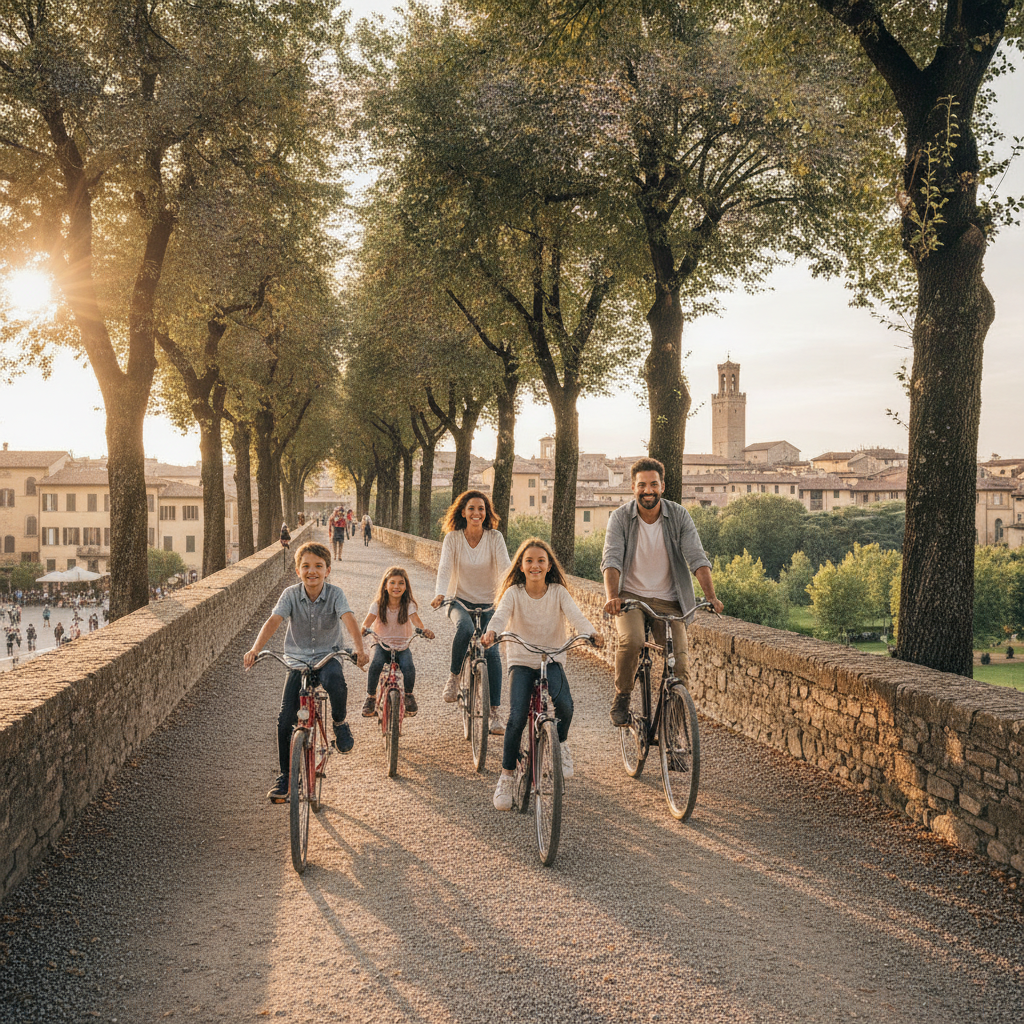
The walls are the heart of it. Lucca’s Renaissance-era city walls stretch approximately four kilometres around the entire historic centre, and they’ve been converted into what is essentially a tree-lined park suspended above the city. They’re wide, flat, shaded by old plane trees and oaks, and completely free of cars. For families, they’re the single best reason to be here.
The walls are the best thing to do in Lucca with kids — not because they’re flashy, but because they solve the fundamental problem of travelling with children in a historic Italian city: how do you let them move freely without worrying about traffic? Up on the walls, toddlers can toddle, older kids can bike ahead, and you can push a stroller on a smooth, flat surface without fighting cobblestones.
There are bike rental shops near the walls offering child seats, tandem bikes, and various family-friendly options. Grab bikes, ride a lap or two, then stop at one of the green spaces along the top for a picnic. The elevated views over terracotta rooftops and out to the Tuscan hills beyond are genuinely lovely — and they’re the kind of views that don’t require you to climb anything or queue for a ticket.
I’d suggest going in the morning or late afternoon. The walls belong to the locals who walk them daily, and the best experience happens when you match their pace rather than treating it as something to tick off. A family trip along the walls works precisely because it’s slow, and the slowness is the point.
If your kids can handle stairs, Guinigi Tower is worth the effort. It’s 130 steps to the top of this fourteenth-century tower, and what waits up there is genuinely unexpected: a rooftop garden planted with holm oak trees, their roots growing right into the medieval stonework. Kids find this properly thrilling — trees on top of a tower, with a panoramic view of the city spread out below. It’s the kind of moment that sticks.
Back at ground level, Piazza dell’Anfiteatro is the piazza families end up loving most. It’s built directly on the footprint of a Roman amphitheatre, so the buildings curve around you in an enclosed oval. The shape matters because it means your kids can run around the open centre while you sit at a table along the edges and actually see them. In a country where many beautiful piazzas open onto streets with scooters and delivery vans, that enclosure is a gift.
For older children — the ones who’ve started to find history interesting rather than boring — the Roman ruins beneath the Church of Santi Giovanni e Reparata offer something genuinely educational. The archaeological excavation underneath the church lets you walk through layers of history, from Roman baths to early medieval foundations. It’s cool, quiet, and underground — which, on a hot Tuscan afternoon, has its own practical appeal. If the weather turns on you, Lucca has plenty to do indoors — check out indoor attractions in Lucca for rainy days.
Piazza San Michele and the cathedral square are worth wandering through too, not because there’s a specific children’s activity waiting but because the open space and the beauty of the Romanesque architecture create the kind of atmosphere where families can breathe. Travel with kids doesn’t need to be a relentless schedule of attractions. Sometimes the best thing is a square, some sun, and nowhere you have to be.
Here’s where Lucca quietly excels. Italian food culture is inherently kid-friendly — not because restaurants design children’s menus, but because the staples of the cuisine are exactly what most children will eat without complaint. Pasta with butter or tomato sauce. Pizza. Focaccia, warm from the bakery. These aren’t concessions to fussy eaters; they’re what the people of Lucca eat too.
For gelato, the place to know is Gelateria Veneta, where the gelato and sorbetto have been made on site for three generations using fresh seasonal ingredients. This is a locally owned business that’s earned its reputation over decades — the kind of place where the money you spend stays in the community. Use it as a reward after climbing Guinigi Tower, or just because it’s two o’clock and everyone’s hot.
A few practical dining notes: Italian families eat late, which means restaurant kitchens often don’t open for dinner until 7:30 or 8pm. If your kids can’t wait that long (and whose can?), aim for an early lunch around noon and grab focaccia or pizza al taglio from a bakery in the late afternoon to bridge the gap. Piazza-side restaurants are your friend — the kids can move around between courses, which is exactly what Italian children do. Nobody blinks.
If you head to the coast at Viareggio or Forte dei Marmi, the beach clubs often serve simpler food at lunch, and the coastal towns have no shortage of places serving pasta. And if you’re a parent who has earned a glass of wine after a long day of tower-climbing and stroller-wrangling, Lucca has you covered there too — have a look at Lucca’s wine bars and local vineyards.
Lucca works beautifully as a base, and that’s partly about geography. The beach is close. The hills are close. Florence is an easy train ride away. You can spend several days here and have a genuinely varied family holiday without ever getting in a car.
Beach days at Viareggio or Forte dei Marmi are the easiest option. The Italian beach-club model — where you rent an umbrella and chairs for the day, with food and drinks available on site — takes most of the logistical stress out of a family beach outing. Everything’s set up. You just show up. For families with active older children, hiking in the Cinque Terre or the hills around Lucca offers more adventurous options, though the Cinque Terre trails can be steep and crowded in summer, so manage expectations.
One of the more distinctive family-friendly experiences is Lucca’s antique fair, which takes place every third weekend of the month, year-round, stretching from Piazza Del Giglio to Piazza Antelminelli. It’s the kind of browsing experience that works for kids and adults — old books, curiosities, hardware, art — and it’s free to wander through. It also keeps the money circulating among local and regional vendors, which matters.
If you’re based in Florence and want a change of pace, Lucca is an ideal day trip. The train gets you there without dealing with Tuscan motorway traffic, and you can learn more about how to get to Lucca from Florence by train, bus, or car. For something quieter still, the charming village of Montecarlo near Lucca makes a gentle half-day outing.
Morning: Start on the walls. Rent bikes and ride the full loop — it takes about 30 minutes at a relaxed family pace, longer if you stop for views and snacks, which you should. Then descend into the centro storico and make your way to Piazza dell’Anfiteatro for a coffee and a pastry while the kids explore the oval piazza.
Late morning: Head to Guinigi Tower. Those 130 stairs will burn off some energy, and the rooftop garden is a genuine reward. If your kids are old enough to be curious about history, walk over to the Church of Santi Giovanni e Reparata and visit the Roman ruins beneath the church.
Lunch: Find a trattoria in the centro storico. Don’t overthink it — pasta, pizza, or focaccia will do beautifully. Sit outside if you can.
Afternoon: Gelato at Gelateria Veneta to celebrate your discoveries. Then let the afternoon unfold at its own pace: wander the pedestrian streets, duck into a church if the kids are willing, browse the antique fair if you’ve timed your visit to the third weekend of the month. Or, if the heat is building and the beach is calling, catch the train or drive to Viareggio and spend the rest of the day at a beach club.
When to go: Spring (April through early June) and early autumn (September into October) give you the best combination of mild weather and manageable visitor numbers. Summer is hot but workable, especially if you balance mornings in the city with afternoons at the beach. Lucca’s carrying capacity as a small walled town means peak summer can feel crowded — visiting in shoulder season respects both your comfort and the town’s.
Strollers and small children: The walls are flat and smooth, perfect for strollers. Some streets inside the centre have uneven cobblestones, so a lightweight stroller or a baby carrier will serve you better than a heavy pram. The flat terrain overall, though, makes Lucca dramatically easier than hill towns like San Gimignano or Volterra.
Where to stay: Inside the walls gives you walkability and the freedom to pop back to your accommodation for rest breaks — critical with younger children. Check out the best neighbourhoods to stay in Lucca for a breakdown of options. Family villas just outside the walls offer more space, gardens, and sometimes a pool — a real advantage in summer. Think about what your family actually needs rather than what looks good on a booking site.
Getting there: Lucca’s train station sits just outside the walls, which means you can arrive from Florence or Pisa by train and walk straight into the old town without ever needing a car. If you do drive, park outside the walls and walk in. The car-free centre is what makes Lucca work for families — don’t undermine it by trying to drive through it.
A final thought: Lucca is a living town, not a theme park. The people who live here — the shopkeepers, the families in the piazzas, the gelato makers who’ve been at it for three generations — are the custodians of this place. The best way to travel here with your kids is to move at their pace, spend your money in locally owned businesses, and teach them, by example, that a good visit leaves a place no worse than you found it. That’s the lesson worth bringing home.