This article includes AI generated content (text, images) obtained with Pressnaut. All content has been fact-checked and manually revised by an human editor.
The first sign is not the crowds. It is the tape. Sometime in mid-October, thin plastic barriers and freshly printed pedestrian-flow signs appear along Via Fillungo, and the shopkeepers who have spent the year arranging their windows with a certain Lucchese restraint begin, quietly, to bolt things down. The city knows what is coming. Most visitors who booked a Tuscan autumn week without checking a calendar do not.
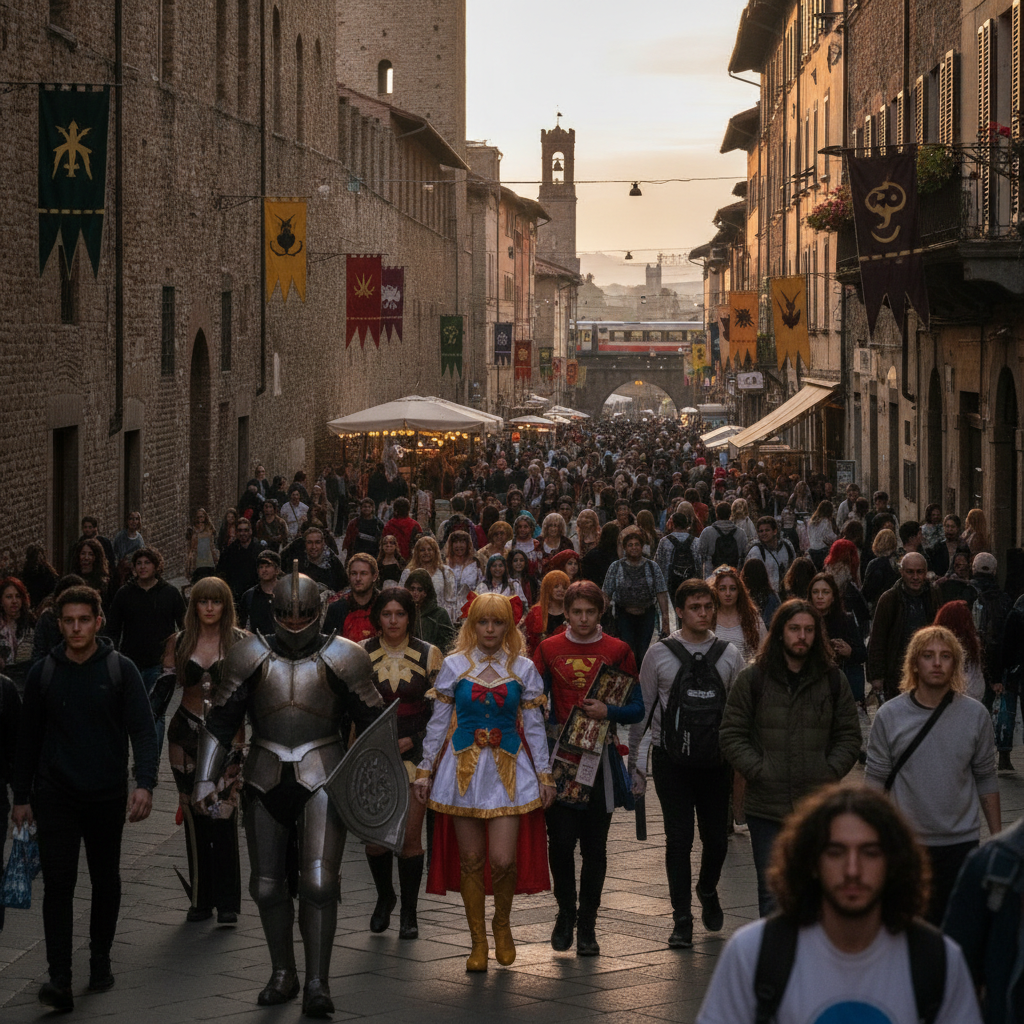
Lucca Comics & Games is, by most reckonings, the largest comics festival in Europe and the second largest in the world after Comiket in Tokyo. That statistic is easy to read past. It is harder to read past when you are standing at Porta San Pietro at eleven in the morning on 1 November, held in place by a slow, good-humoured, immovable current of several hundred thousand people.
The event has deep roots. Its origins go back to 1966, as Il Salone Internazionale dei Comics, with the modern Lucca edition running in its current form since 1996 and traditionally landing on the last weekend of October. What distinguishes it from a convention is geography. There is no single hall to enter and leave. Pavilions, tents and themed areas occupy the piazzas inside the sixteenth-century walls, while Japan Town sits out at the Polo Fiere along with other satellite zones. The historic centre is not a backdrop. It is the venue.
For 2025, the dates are 29 October to 2 November, with exhibitions open from 18 October. The theme is French Kiss, France is guest of honour, and the poster is by Rébecca Dautremer — a choice with actual craft behind it, which is not always the case with festival artwork.
Tickets come as single days or multi-day passes, and the single most consequential decision you will make is which day. Because the festival is traditionally held in conjunction with All Saints’ Day, 1 November functions as a national holiday funnel: Italian families, day-trippers and everyone who could not take Thursday off arrive at once. Wednesday and Thursday are meaningfully calmer for the same programme.
Buy online, well ahead, and collect or validate your pass early — ideally the evening before, or before nine in the morning. The queue to convert a confirmation email into a wristband is a separate and entirely avoidable queue.
Newcomers also misunderstand what the ticket buys. The streets, the walls, the cosplayers, the buskers and most of the theatre of the thing are free; you cannot fence a walled city. The ticket admits you to the pavilions, the exhibitor halls, the panels, the tournaments and the ticketed exhibitions. The atmosphere of cosplayers, gaming tournaments, artist panels and anime and sci-fi exhibitions spread throughout the city is, in large part, simply happening around you.
The 2025 guest list leans heavily literary and Anglo-American: Rick Riordan, Holly Black, Cassandra Clare, Kevin Eastman, John Romita Jr., Aleksi Briclot and Magali Villeneuve among them. Signing lines for names of that order form early and close early; if a signature is the point of your trip, plan the whole day around it and accept that you will see little else.
The Games side continues to grow. The section is expanding significantly, promising exclusive previews, tournaments and special editions — the kind of limited print runs that sell out within hours of the doors opening. Video game and pop culture crossovers, at the Kojima end of the spectrum, draw their own dedicated crowds, and the festival once again hosts artists, publishers and creators from all over the world.
The strategy that works is unglamorous discipline: choose one, at most two, ticketed commitments per day. Treat everything else as a street festival you happen to be walking through. People who try to execute a full schedule spend the week queuing and remember nothing but the backs of strangers’ heads.
Inside the walls, rooms go six to twelve months ahead, and rates multiply — three and four times ordinary October pricing is routine. This is where I will say what a hotelier would not: at those prices, judge the property by whether the staff are being supported or merely deployed. A well-run small hotel during Comics week is a masterpiece of logistics — early breakfasts, luggage held for guests arriving before check-in, someone at the desk at midnight who still means their greeting. A badly run one simply raises the price and hopes you are too tired to notice.
If the centre is gone, look outward without embarrassment. Pisa is twenty-five minutes by train and hotels there market openly to festival-goers — Palazzo Feroci among them. Viareggio on the coast, Montecatini, Altopascio, Capannori and the villages of the Lucca plain all work. Florence is viable for a single day, less so for four.
The trade-off is real and worth naming. Staying inside the walls means walking home through a city still lit and murmuring at one in the morning. Staying outside means sleep, air, and a bill you will not resent. If you are weighing the geography carefully, our guide to where to stay in Lucca, inside and outside the walls, is a useful starting point, and further practical festival planning notes reinforce the same message: book absurdly early.
Come by train. This is not a preference; it is the only sane option. Lucca’s station sits a few minutes’ walk from Porta San Pietro, and services from Pisa, Viareggio, Florence and Montecatini run frequently, with additional capacity during the festival.
Driving in is effectively closed off. The ZTL is extended, vehicle access inside the walls is largely banned outright, and because the exhibitions are spread throughout the city, pedestrian flows are reconfigured into one-way routes that will not match your map application. Park-and-ride lots outside the walls, with shuttle buses, are the fallback — and they fill by mid-morning. Note too that the split between the historic centre and Japan Town at the Polo Fiere requires a shuttle or a long walk; budget an hour for the round trip.
Day-tripping is entirely feasible if you commit to the early train and accept a late one home. Our Florence-to-Lucca day trip guide covers the timings; during festival week, ignore the car option entirely.
Reserve. Weeks ahead. Walk-ins inside the walls at eight in the evening on the Saturday are, in practical terms, not a thing that happens. The restaurants that matter in Lucca are small, family-held rooms with twenty covers and a kitchen that will not be rushed, and they are right not to be.
Failing a reservation, shift your hours. Lunch at noon, before the Italian rhythm begins; dinner after 21:30, when the first sitting clears. And move laterally — one or two streets off the main pavilion axes, the pressure drops noticeably. The street food villages and the Japan Town stalls are the honest fast option, and better than they need to be.
In the evening, the enoteche are the refuge. A glass of Colline Lucchesi red in a room with thick walls and low light, thirty metres from a piazza containing four thousand people, is one of the more civilised sensations the week offers; our Lucca wine bar guide lists the calmer ones. The festival has been transforming these streets and squares for many years; the wine bars have learned to absorb it gracefully.
You have not lost the city. You have lost the middle of the day.
Before nine in the morning, Lucca is genuinely yours: the walls empty and damp, the light low and gold across the plane trees, San Michele’s facade unphotographed, the market vendors setting up. Take our self-guided church walk at eight and you will finish it before the first pavilion opens.
Use the pre-festival exhibition window from 18 October for a calmer version of the same content. And keep escape routes: the northern stretch of the walls stays comparatively quiet, and the Colline Lucchesi, Pisa, Viareggio and Bagni di Lucca are all within an hour.
With children, be blunt with yourself. Strollers do not work in peak crowds. Agree a meeting point, write your phone number on a card in their pocket, and plan mornings and hills rather than afternoons and piazzas; our Lucca with kids itinerary adapts well to festival week.
Carry cash — many stalls take cards, but connectivity collapses under the load. Bring a portable charger, layers for late-October Tuscan weather that swings from twelve to twenty-two degrees in a day, a compact rain shell, and shoes you have already broken in. Cosplayers should check prop regulations before travelling, plan for changing areas rather than hotel-room transformations, and consider what rain does to worbla and paint.
If you have one day only, take the Wednesday or Thursday. Avoid 1 November unless crowds are part of the appeal. And if this year’s edition is full, start now for the next one: 2026 planning information is already circulating, and hotels are marketing Lucca Comics 2026 before this year’s tents come down. That, more than any attendance figure, tells you what kind of week this is.