This article includes AI generated content (text, images) obtained with Pressnaut. All content has been fact-checked and manually revised by an human editor.
The glass arrived without ceremony — a pale straw-colored Vermentino, still cool from the cellar, set on a marble counter worn smooth by decades of elbows. The woman behind the bar said nothing about it except the name of the vineyard, which was ten minutes away by bicycle. That quiet confidence — wine from just over the wall, poured without performance — is the whole of Lucca’s wine identity, compressed into a single gesture.
Travelers in Tuscany tend to move through Lucca on their way to Chianti, Montalcino, or Montepulciano, treating the walled city as a layover rather than a destination with its own viticultural depth. This is a mistake. The province of Lucca holds two DOC denominations — Colline Lucchesi DOC and Montecarlo DOC — as well as IGT designations including Costa Toscana IGT and Toscano IGT, giving the area a range and seriousness that most visitors never encounter. The city itself, within those famous Renaissance walls, sustains a quiet enoteca culture where these wines are poured alongside local salumi and pecorino, and where asking the right question can open an entire afternoon of discovery.
If you have already explored the Montecarlo wine village as a day trip, what follows goes further — into the lesser-known appellations, the grape varieties that distinguish the Lucchesia from the rest of Tuscany, the wine bars worth your evening, and the self-guided vineyard routes that begin just beyond the city gates.
The Colline Lucchesi DOC was created in 1968, making it one of Italy’s earlier DOC designations — a fact that surprises those who assume this corner of Tuscany arrived late to serious winemaking. The appellation is centered near the commune of Lucca and encompasses two non-adjacent zones in the hills to the north and east of the city, where the terrain shifts from the flat Lucchesia plain into the kind of undulating landscape that rewards viticulture.
The terroir here is distinct from the clay-heavy soils of Chianti or the limestone ridges of Montalcino. The region’s topography comprises rolling hills with a Mediterranean-influenced climate moderated by proximity to the Ligurian coast, producing wines that tend toward aromatic softness rather than the austere tannin structure found further south. The elevation is modest, the drainage good, and the resulting wines carry a lightness that feels calibrated to the local cuisine — which favors farro, beans, and roasted meats over the heavier ragùs of Florence.
Montecarlo DOC, the second appellation, occupies a small hilltop zone southeast of Lucca and produces wines with a markedly different character, owing largely to its unusual grape heritage. Where Colline Lucchesi stays close to the traditional Tuscan playbook, Montecarlo has incorporated French varieties since the nineteenth century, lending its wines a cosmopolitan inflection that is rare in the region. Both appellations produce Rosso DOC, Bianco DOC, and Vin Santo, as well as DOP extra virgin olive oil — a reminder that in the Lucchesia, vine and olive tree have always shared the same slopes.
Sangiovese is the backbone, as it is across Tuscany, but what happens around it is where the Lucchesia distinguishes itself. A typical Colline Lucchesi red — such as those from Fattoria di Fubbiano in San Gennaro — blends 70% Sangiovese with 15% Canaiolo and 15% Ciliegiolo, reaching around 14.5% ABV. The effect of those secondary grapes is significant: Canaiolo rounds the mid-palate, softening Sangiovese’s natural acidity, while Ciliegiolo contributes a cherry-inflected perfume and a floral lift that you simply do not find in Chianti Classico. The nose tends toward the delicate — greenhouse herbs, light perfume, a faint green steminess — rather than the dark fruit and leather of more southern Tuscan reds.
The whites lean on Trebbiano Toscano and Vermentino, sometimes with inclusions of Grechetto and Malvasia, producing wines that are lighter and more coastal in style than Vernaccia di San Gimignano or the Chardonnay-driven whites of Bolgheri. They are aperitivo wines, best served cold and without pretension, and they pair instinctively with the seafood that arrives daily from the Versilia coast.
Montecarlo’s distinction lies in its French grape heritage. Syrah, Roussanne, and Sémillon were introduced to the area in the nineteenth century and remain permitted within the DOC regulations — a rare allowance that gives Montecarlo wines a texture and aromatic complexity unusual for Tuscany. The Vin Santo produced across both appellations follows the traditional dried-grape method, with clusters hung in well-ventilated rooms before pressing and long barrel aging, yielding dessert wines of amber depth and honeyed restraint.
The enoteca culture within Lucca’s walls is modest in scale but serious in intent. These are not wine bars designed around a concept or a décor budget; they are rooms where wine is stored properly, poured at the correct temperature, and accompanied by food that exists to complement what is in the glass rather than to photograph well. The best of them carry Colline Lucchesi and Montecarlo wines on their lists — though you will sometimes need to ask, since the default pour for tourists often defaults to Chianti or Brunello, wines the staff assume visitors already know.
The useful strategy is a direct one: ask specifically for Colline Lucchesi wines, and watch how the person behind the bar responds. A good enoteca will have at least two or three local producers available by the glass, and the staff will know the vineyards by name. A mediocre one will offer you a Rosso di Montalcino and change the subject. The distinction tells you everything about whether you are in a place that values its own territory or merely services passing traffic.
Pair whatever you are drinking with pecorino from the Garfagnana, farro-based soups if the kitchen offers them, and the local salumi — particularly the biroldo, a blood sausage specific to the Lucchesia that is far more refined than the name suggests. A tagliere and two glasses of Colline Lucchesi rosso will cost between €15 and €25 at most addresses, which, by any Tuscan standard, represents genuine value.
Wine bars also serve as the natural rainy-day alternative when vineyard visits are impractical, and they make excellent use of the evening hours after sightseeing. If you are deciding where to stay in Lucca, proximity to the centro storico places the best enotecas within a few minutes’ walk.
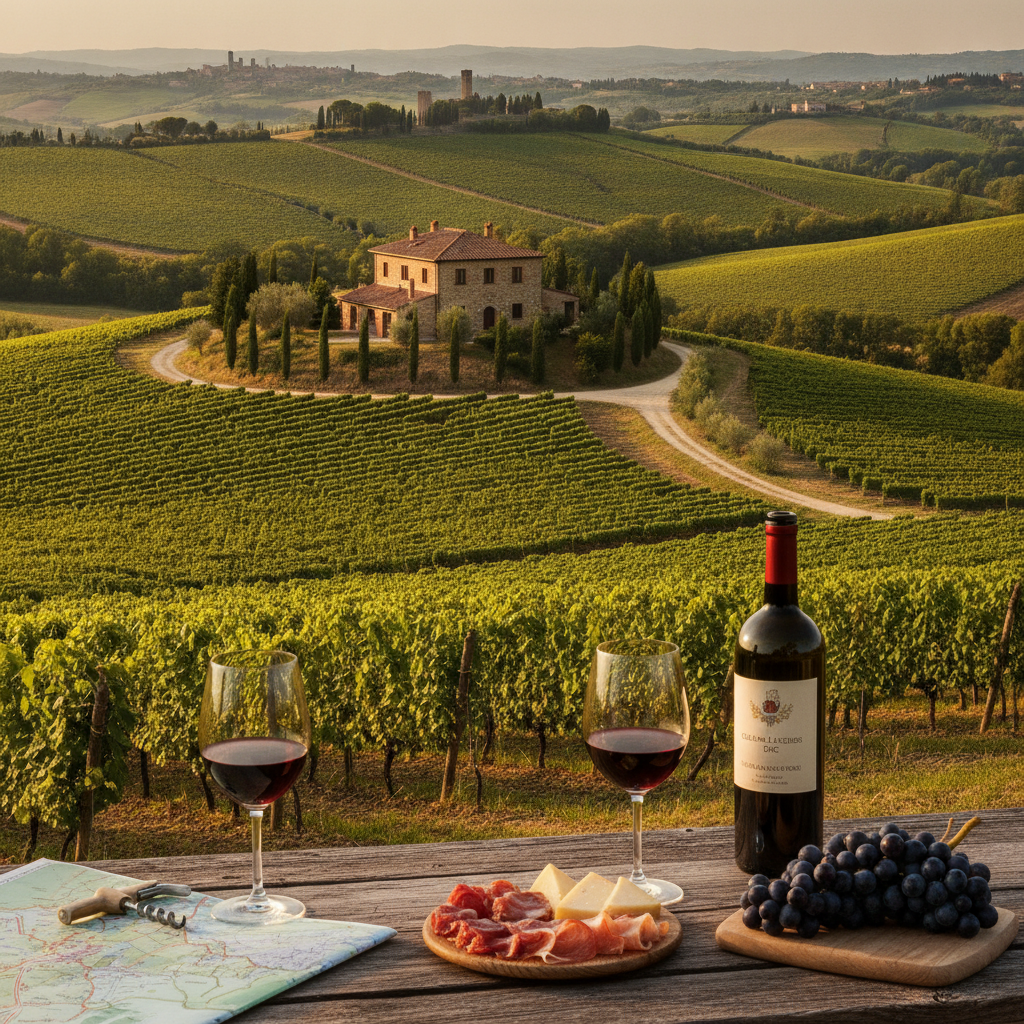
What makes Lucca unusual as a wine destination is proximity. The vineyards are not a day trip away; they begin in the hills just outside of the city center, reachable by bicycle in fifteen to twenty minutes from the walls. The Strada del Vino delle Colline Lucchesi is the official wine road connecting these estates, and it requires no organized tour, no guide, and no bus — only a willingness to ride or drive a short distance into landscape that shifts, quickly and without drama, from urban to agricultural.
Cycling is the most satisfying way to approach. The initial stretch from the walls is flat, following quiet roads before the terrain begins to climb gently into the hills. An e-bike makes the return trip comfortable after a tasting or two. Driving is straightforward for those visiting three or more estates, though a designated driver becomes a practical concern. Local buses connect some of the villages along the route, but schedules are infrequent, and the flexibility of a bicycle or car is preferable.
A self-guided visit requires one thing that many travelers neglect: booking ahead. Most estates in the Lucchesia are small, family-operated, and do not maintain tasting rooms staffed at all hours. A phone call or email the day before — or earlier during harvest season — is not formality but necessity. Tastings typically include three to five wines, often paired with the estate’s own olive oil, and last between forty-five minutes and an hour. Expect to pay between €10 and €20 per person, often waived with a purchase.
Fattoria di Fubbiano, located in the village of San Gennaro, is among the most recognized names in the Colline Lucchesi appellation. The estate produces the classic regional blend — Sangiovese with Canaiolo and Ciliegiolo — and its wines retail at approximately $20 internationally, meaning cellar-door prices are substantially lower, often in the €10–15 range. The tasting experience is unhurried and agricultural in the best sense: you are in a working farm, not a showroom. The nose of their rosso tends toward the light and perfumed, with an herbal undertone that reflects the surrounding hillside rather than oak-driven winemaking decisions.
Tenuta Adamo offers a more contemporary experience, combining wine tastings and events with agriturismo accommodation surrounded by vineyards. For visitors who want to wake up inside the landscape rather than commute to it, the estate’s apartments provide a base from which the Strada del Vino can be explored at a pace that does not feel like tourism. The wines are produced with an eye toward accessibility, and the staff are accustomed to receiving guests who are new to the Lucchesia’s offerings — making it a good starting point for those still learning the vocabulary of the region.
Additional producers along the Strada del Vino can be found through local winery directories, and the consistent advice applies: contact directly, arrive on time, and buy what you genuinely liked rather than what seems like the most impressive bottle. These are wines made in small quantities, and supporting the producers at the cellar door is not a transaction but a relationship, even if a brief one. For those considering staying outside Lucca’s walls, an agriturismo on the wine road offers both economy and immersion.
The best months for vineyard visits are September and October, when the harvest is underway and the hills carry the particular smell of crushed grape skins and turned earth — but tastings are available year-round, and the quieter months of March through May offer the advantage of unhurried attention from producers who are not simultaneously managing a harvest crew.
A half-day itinerary works well for those arriving from Florence by train: spend the morning walking the walls and exploring an enoteca or two inside the city, then cycle or drive to one or two vineyards on the Strada del Vino in the early afternoon, returning to the centro storico for an aperitivo as the evening light turns the brick façades the color of terra cotta. A full day allows for a more ambitious route — morning tastings in the Colline Lucchesi, followed by an afternoon in Montecarlo village, where the hilltop setting and the French-influenced wines provide a genuine contrast.
For those staying longer, the thermal baths at Bagni di Lucca combine well with a wine-focused itinerary — a morning of tastings followed by an afternoon of mineral water, a sequence that makes a certain physiological sense.
The practical considerations are few but important. E-bikes can be rented from several shops inside the walls. Most vineyard tastings require advance booking — do not simply arrive. If you are driving, designate someone who will spit rather than swallow, or limit yourself to a single estate. And carry cash: smaller producers do not always accept cards, and a fifteen-euro bottle of Colline Lucchesi rosso, purchased directly from the person who made it, is one of the most quietly satisfying transactions available in Tuscany.
What Lucca offers, in the end, is not the drama of more famous wine regions but something more durable: proximity, affordability, and the particular pleasure of wines made without the pressure of global reputation. These are wines that taste like where they are from, poured by people who have not yet learned to perform enthusiasm because theirs is still genuine. That is worth the bicycle ride.