This article includes AI generated content (text, images) obtained with Pressnaut. All content has been fact-checked and manually revised by an human editor.
Picture yourself at 9:40 on a Tuesday morning in Piazza San Martino, coffee still warm in your stomach, the marble facade in front of you catching light from the east. Nobody is queuing. A verger is unlocking a side door. This is the hour Lucca gives its churches away for almost nothing, and it is the hour most visitors spend deciding what to do.
So let’s decide it for you. What follows is a single loop — four churches, roughly 1.5 flat kilometres, three hours — sequenced around light, opening patterns and ticket logic rather than alphabetical order. It is not a monument checklist. It is a route with a rhythm.
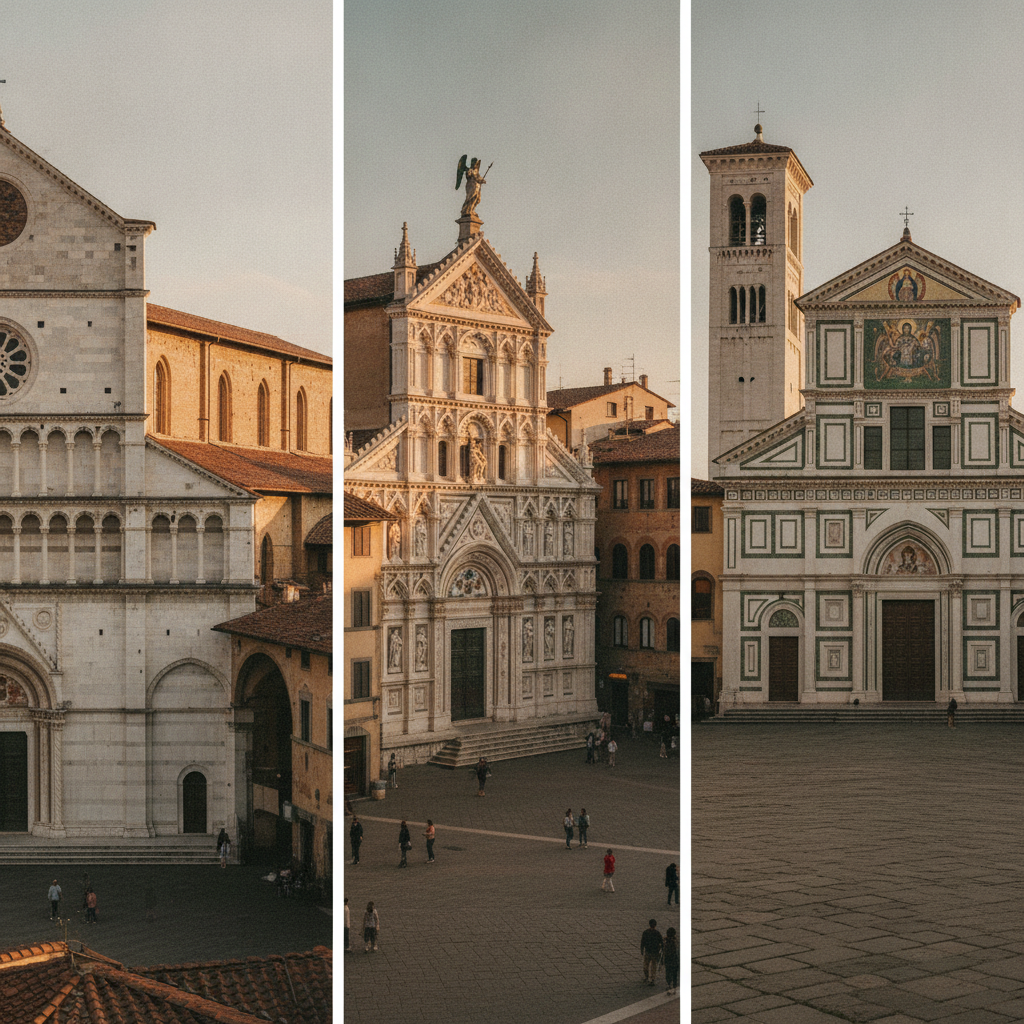
Lucca was once called the city of a hundred churches, and while the count is generous, the density is real: the walled centre packs tiered arcaded facades within a quarter-hour walk of each other. The style is Pisan-Romanesque — layered loggias, striped marble, sculpted portals — and because Lucca stayed independent and prosperous for centuries, it kept building without ever demolishing much.
San Martino is the cathedral of Lucca, the city’s principal church and the anchor of this walk. Around it: San Michele in Foro on the old Roman forum, San Frediano with its gold mosaic, and — the stop nobody tells you about — tiny San Salvatore, which one visitor found “empty, silent, and unguarded,” the only person inside.
This route suits independent travellers, art-minded ones, families willing to slow down, and anyone caught out by weather — most of these three hours are spent under a roof, which makes it a natural companion to other indoor plans for Lucca in the rain. If you’re still planning logistics, note that everything here is inside the walls, which is one good argument among several for where to stay in Lucca.
Total distance is around 1.5 km, entirely flat and pedestrianised, with cobbles that punish thin soles. Start between 9:30 and 10:00: you get raking morning light on San Martino’s west-facing marble before the sun climbs flat, and you finish before the midday break shuts doors around you.
Ticket logic first, because it shapes the order. The museum and archeological complex of Lucca Cathedral “brings together the cathedral, its museum and the church and archaeological area of Santi Giovanni e Reparata” under one combined visit. Buy that at the start and stops one and two are covered.
Dress code is not decorative. Shoulders and knees covered in all four churches, no exceptions at the Duomo. No flash, ever — pigment and gilding do not forgive it.
The building is a palimpsest. A church stood here in the 6th century; at the beginning of the 8th the bishop’s seat moved in, and the cathedral was dedicated to Saint Martin of Tours. It was rebuilt in 1070 under Pope Alexander II and enriched through the 15th century — Romanesque structure, Gothic detail, Renaissance harmony layered on top, as the provincial museum system describes it.
Stand back before you go in. The facade is deliberately asymmetrical: the right-hand arch is compressed because the pre-existing campanile refused to move. It is one of the most honest pieces of medieval problem-solving in Tuscany, and it produces a marble cathedral with magnificent Romanesque sculptures on its facade that looks improvised and inevitable at once.
Three things, in this order. The equestrian relief of Saint Martin dividing his cloak, on the right-hand pier — the original is inside, sheltered. The small carved labyrinth on the right pillar of the portico, worn smooth by centuries of tracing fingers; put yours there too, it’s the point. And the 13th-century sculpted cycle of the months above the doors, which reads as an agricultural calendar in stone.
Inside, work the right aisle first: Tintoretto’s Last Supper, dramatically lit and diagonally composed, then Ghirlandaio’s altarpiece in the sacristy area. Allow 45 to 60 minutes in total. The nave is dim by design; brace your camera against a pillar rather than pushing ISO past usefulness.
The legend is better than any interpretive panel. Nicodemus carved the body of Christ, but fell asleep before carving the face. When he awoke, the face was complete. Hence Volto Santo — the Holy Face, not made by human hands. The crucifix reached Lucca by sea and ox-cart, and it made the city a pilgrimage stop on the Via Francigena for centuries.
You’ll find it in the left nave, housed in Matteo Civitali’s octagonal marble tempietto of 1484 — a small temple built to frame a much-revered crucifix, as Sacred Destinations puts it. Look at the tempietto as well as its contents: Civitali’s Renaissance clarity wrapped around a Romanesque object of devotion is the whole history of Lucca in one metre of marble.
If your dates are flexible, come in September. An annual candlelit procession on 13 September, the Luminara, is devoted to the Volto Santo, walking to the cathedral from the Basilica of San Frediano. Street lighting goes off, window ledges fill with candles, and the whole route you’re about to walk becomes a single line of flame.
Jacopo della Quercia carved Ilaria del Carretto around 1406, shortly after the young second wife of Paolo Guinigi died in childbirth. She lies with her hands folded, drapery falling in soft parallel folds, a small dog curled at her feet — the conventional symbol of marital fidelity, rendered with entirely unconventional tenderness. It is one of the most admired works of Renaissance funerary sculpture.
It sits in the sacristy, which normally requires the museum or combined complex ticket rather than plain cathedral entry — the cathedral “houses many works of art” and they are ticketed accordingly. Check at the desk rather than assuming.
Walk a full circle. From the foot you read the dog and the drapery; from the side you get the profile and the pillow’s compression; from the head end you see how della Quercia softened the jaw. Then drop your eyes to the sarcophagus and follow the frieze of putti carrying garlands — antique-derived, and among the earliest such motifs in Tuscan sculpture.
Light is low and warm-toned. Shoot at the widest aperture you have, steady your elbows on the rail, and expect to correct heavily toward blue in post. No flash, no tripod.
Cross the piazza to Santi Giovanni e Reparata — Lucca’s original cathedral, and beneath it an excavation that stacks a Roman house, a paleochristian baptistery and successive church floors into one descent. It’s included in the combined ticket, it’s cool in August, and it explains everything you just saw upstairs. Twenty minutes is plenty.
Then, later in the walk, slip into San Salvatore, one of Lucca’s small and lesser known churches — a favourite of locals. Free, usually empty, two minutes off the line between San Michele and San Frediano. These minor stops are what turn a monument list into a morning you remember, and they’re forgiving of short attention spans if you’re exploring Lucca with kids.
The name is literal: the church stands on the Roman forum, and the piazza still holds the forum’s rectangular footprint. Look up and you’ll notice the loggia facade continues well above the roofline of the nave behind it — a screen built for an enlargement that never happened. Lucca’s churches share this distinctive Pisan-Romanesque style of tiered arcaded facades, and here the type is pushed to its theatrical limit.
Then look closer at the columns. During the 19th-century restoration, sculptors slipped portrait heads of Risorgimento figures — Garibaldi, Cavour, Pius IX among them — into the inlaid colonnettes. Finding them is a good five-minute game. On top, the winged Archangel Michael spreads metal wings above the pediment; inside, a Filippino Lippi panel of four saints repays the walk to the right transept.
Entry is free, 20 to 30 minutes is enough, and the west-facing facade glows around 5pm — which pairs neatly with a glass of Colline Lucchesi afterwards if you’re rearranging the loop for evening light.
San Frediano honours the Irish bishop who, according to the diocesan record, founded the cathedral in the sixth century — the same figure, closing the circle on your morning.
The facade breaks Lucca’s pattern completely: instead of arcades, a vast 13th-century mosaic of the Ascension, Christ rising between angels above the apostles, gold tesserae on a plain upper wall. It is unique in the city and it needs sun. Afternoon light, ideally 3–6pm, when the gold stops reading as brown.
Inside: the extraordinary Romanesque baptismal font, carved with the story of Moses and the Good Shepherd; the Trenta Chapel with more work by Jacopo della Quercia; and, in a glass case, the mummified body of Santa Zita, the 13th-century servant girl who became Lucca’s most domestic saint. And each 13 September, the procession walks to the cathedral from the Basilica of San Frediano — you’ll be standing at the starting line.
Buy the combined cathedral complex ticket at the San Martino desk. It bundles the cathedral, the museum and the Santi Giovanni e Reparata archaeological area; single entries exist but rarely make arithmetic sense if you want the sacristy. San Michele charges nothing, San Frediano asks a small contribution. Verify current prices and hours with the official complex page before you set out, and treat the historic dating — St. Martin, 1070–15th century — as your reminder that these are working parishes, not exhibition halls.
If rain closes the day down entirely, the same historic centre offers plenty of indoor alternatives; if you finish by noon and want more Tuscany, a day trip to Montecarlo fits comfortably into the afternoon.
Three hours, four churches, one labyrinth traced with your thumb. Lucca’s sacred art doesn’t ask for reverence so much as attention — and it rewards the visitor who arrives at 9:40 rather than 11:40.