This article includes AI generated content (text, images) obtained with Pressnaut. All content has been fact-checked and manually revised by an human editor.
The first thing many people notice in Lucca is the sound. Not traffic, exactly, though there is some beyond the gates, but the softer hum of bicycle wheels on gravel atop the walls, church bells slipping across the rooftops, and footsteps on stone that seem to slow down the moment you enter the center. Coming from Florence, where a day can feel tightly laced from breakfast onward, Lucca lands differently. It gives you room.
That is what makes it such a good independent day trip from Florence. You do not need a guided tour, a heroic early start, or a rental car unless you genuinely want one. For most travelers, the simplest and best plan is also the least dramatic: take the train, walk into town, circle the walls, have a proper lunch, and let the day unfold at a human pace.
Lucca works in one day because its main pleasures are close together and easy to reach on foot. The historic center sits neatly inside its Renaissance walls, and once you are through the gate, the city reads clearly: elegant streets, church facades in pale stone, quiet piazzas, and a layout that rewards wandering rather than military-grade scheduling. It is one of those places that looks composed without feeling stiff.
Among the many day trips people consider from Florence, Lucca stands out for being both beautiful and manageable. Walks of Italy describes it well: “Lovely Lucca offers up cobblestoned streets and elegant palaces, elaborate churches and a ring of Renaissance-era fortification walls that have been turned into biking and walking paths.” That ring matters more than it may sound on paper. The walls are not just a monument; they are the city’s breathing space, a green promenade and an easy orientation tool for first-time visitors.
Lucca is also refreshingly realistic for independent travelers based in Florence. According to Earth Trekkers, “Siena, Bologna, Pisa, Lucca, and Arezzo are all easy by train or bus.” In Lucca’s case, that ease is especially useful because the station is close to the center and the town itself does not demand complicated logistics once you arrive.
If you are comparing options and hoping for the least fussy route, the editorial consensus is pretty clear. One Step 4Ward puts it bluntly: “If you’re planning a Florence to Lucca day trip, taking the Florence to Lucca train is by far the most convenient way to travel.” I would agree. As an American, I understand the reflex to over-plan transportation as if Tuscany were a timed obstacle course. Lucca does not require that energy.
If you end up loving the place and start wondering what it feels like after sunset, that is a different rhythm entirely. I have written more about that here: Lucca by night. For a day trip, though, the point is its calm. You can arrive independently, see a great deal without rushing, and return to Florence before the day turns ragged around the edges.
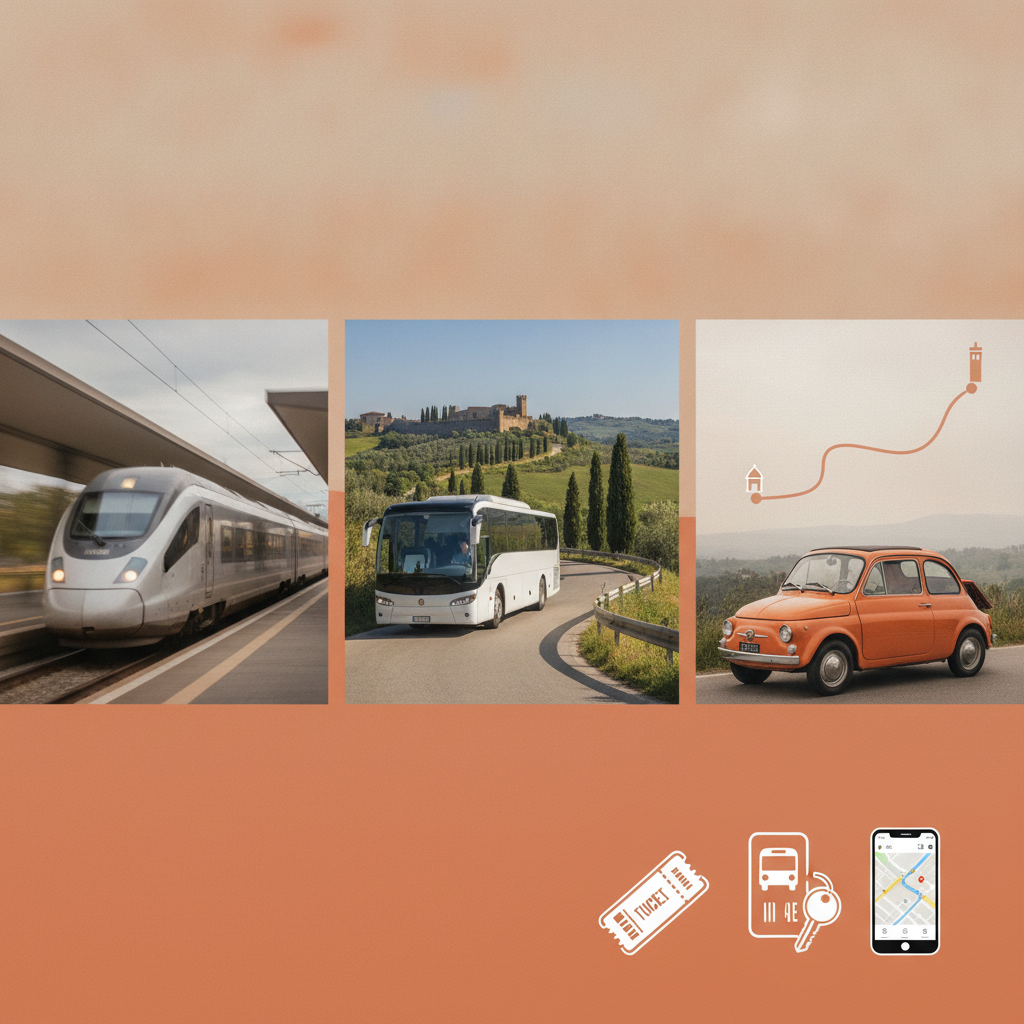
If you are searching for the short answer to how to get from Florence to Lucca, here it is: take the train unless you have a specific reason not to. Driving comes second if you want flexibility beyond Lucca itself. Bus is possible, but for most visitors staying in central Florence, it is the least practical of the three.
This hierarchy is not especially glamorous, but it is honest. The Florence Insider notes that “There are basically two options to go from one to another: train or car. If you’re asking me which is the best way to go from Florence to Lucca (and vice versa) my answer is definitely the train, for more than one reason.” That matches the experience of most travelers who are starting from Florence and just want a smooth day.
Visit Florence adds that Lucca “can be reached by either train or bus,” while recommending the train. That recommendation matters because convenience in Italy is often less about pure distance than about friction: where you depart, how often services run, and how close you arrive to where you actually want to be. Lucca is kind to train travelers on all three counts.
Car travel has its place, but not because Lucca itself requires one. As Earth Trekkers points out, “A rental car is not necessary for every day trip, but it significantly expands your options.” That is exactly the right frame. If your goal is simply one day inside Lucca’s walls, rail is usually the cleaner choice. If your goal is Lucca plus a winery, a hill town, or a thermal stop somewhere beyond, then the car begins to earn its keep.
Travelers who want to continue beyond Lucca might also find these useful: a Lucca to Versilia Coast guide if you are thinking sea air, or other onward trips once you are based here. But for Florence to Lucca and back in one day, the train remains the practical winner.
The Florence to Lucca train is usually the best choice because it balances all the things day-trippers actually need: straightforward departure, decent frequency, reasonable fares, and an arrival point close to the historic center. It also removes the low-grade stress of parking, traffic, and navigating a city you are not planning to explore by car anyway. There is a quiet luxury in stepping off a train and simply walking into town.
According to Trainline, the route covers 61 km, and “the train from Florence to Lucca usually takes 1 hour 32 minutes on average to travel 61 km, although the quickest services can take as little as 1 hour 4 minutes.” That spread is worth paying attention to. Not every departure is equally fast, and the quickest journeys may be less regular than the standard regional options.
Frequency is another reason the route works so well for a day trip. Trainline says, “You can expect to find 41 trains per day running on this popular route. Good news! There are direct trains available to Lucca.” Visit Florence similarly notes that trains leave about twice an hour from Santa Maria Novella, which is exactly the kind of cadence that makes a day feel flexible rather than brittle.
Fares are also relatively gentle by Tuscan day-trip standards. Trainline lists prices starting from €8.40, which helps keep Lucca in the category of easy outing rather than logistical project. For travelers staying in Florence, that matters. You can decide on the trip without feeling as if you are committing to a minor expedition.
The practical advice here is simple. Check the schedule in advance, especially if you are aiming for one of the faster departures or trying to line up lunch at a specific hour. Pack the Suitcases notes that “It takes around an hour and 20 mins to get to Lucca Station from Florence (check times on Trenitalia). Trains are regional but the quicker service is not that regular.” In other words: do not assume every train performs like the fastest one.
Arrival is pleasingly easy. Lucca station sits just outside the walls, so you are not dealing with a long transfer or a confusing suburban drop-off. Visit Florence notes that the station is located just a short walk from the center, and that convenience changes the shape of the day. You can be on the walls within minutes, which is far more satisfying than spending your first half hour trying to decode a local bus map under pressure.
If the weather turns sour, train is still the least troublesome option. You can adjust your pace, duck into churches and cafés, and use a rainy-day plan without wrestling with a car. If that becomes relevant, I have a fuller guide to Lucca in the rain. The city wears drizzle better than many places do; the stone darkens, the piazzas hush, and everyone carries on.
Choose the train if you are staying near Santa Maria Novella, if you want the easiest independent day trip, or if your plan is mainly to explore inside Lucca’s walls. It is especially good for first-time visitors, solo travelers, couples, and anyone who would rather spend their energy on the town than on transportation. Which, after years in Italy, I have learned is usually the wiser bargain.
Bus exists as an option from Florence to Lucca, but it is not the one I would lead with for most travelers. Visit Florence confirms that Lucca can be reached by bus as well as train, yet still recommends rail. That tells you something. When a destination is this easy by train, the bus tends to become the backup plan rather than the star.
There are cases where bus might suit you: perhaps your lodging makes the departure point easier, perhaps fares line up well on a particular day, or perhaps you simply prefer bus travel. But for a one-day visit, bus generally asks a little more of you in exchange for rather little. It is usually less intuitive, often less comfortable for this kind of outing, and seldom improves your arrival experience.
Driving from Florence to Lucca makes more sense when Lucca is only part of the plan. If you want to combine the city with a vineyard stop, a village in the hills, or a thermal detour, then a car gives you the kind of freedom trains cannot. This is where Earth Trekkers’ point lands well: “A rental car is not necessary for every day trip, but it significantly expands your options.”
That expansion matters most outside the city. Once you are in Lucca itself, a car becomes slightly awkward luggage. You do not need it inside the walls, you will need to think about where to leave it, and city access always comes with more caveats than visitors expect. Italy has a talent for making drivers feel confident and chastened in the same ten-minute span.
The Florence Insider’s preference for train over car is sensible here too. If your only aim is Florence to Lucca and back, the car introduces parking and navigation concerns without giving much in return. If, however, you are extending the day outward, driving can be useful for places that are less straightforward by public transport, such as a wine-focused stop in Montecarlo, Tuscany or a wellness detour to Bagni di Lucca.
So the practical recommendation is this: take the bus only if it clearly suits your schedule better than rail, and drive only if Lucca is one stop in a broader day. Otherwise, take the train and keep your life simple. In Tuscany, that is often the most sophisticated choice, even if it feels suspiciously undramatic to those of us raised on the mythology of the open road.
The best one-day Lucca itinerary is not the one that tries to tick every church and tower before lunch. It is the one that uses the city’s compact shape to your advantage. Start at the station, enter the center on foot, walk part of the walls early, and let the old town open gradually. Lucca rewards attention more than speed.
From Lucca station, it is a short walk to the historic center. This is one of the city’s great practical gifts: there is no drawn-out approach. Within minutes, you can be climbing onto the walls, that broad ring of green and packed paths described by Walks of Italy as a biking and walking route encircling the city.
Do this first if you can. Morning light is kinder, the air is fresher, and the walls give you an immediate sense of orientation. Walk a generous stretch rather than insisting on the full loop if time feels tight. You will see treetops, church domes, fragments of terracotta roof, and locals moving through their day with the unfussy confidence of people who are not on a day trip.
After the walls, head into the old town and take the main streets without treating them like a checklist. Lucca’s pleasure lies partly in its texture: shopfronts tucked under stone arches, bicycles leaning against walls as if they have simply paused for conversation, polished door knockers, the cool slip of shade on narrow lanes. This is where visitors often realize the city is calmer than Florence, Pisa, or Siena, and that calm is not emptiness. It is proportion.
You can shape your route around the principal churches and piazzas, but leave space for detours. A church facade catches the light differently at 11 a.m. than it does at 3 p.m.; a side street may offer a quieter, more honest memory than a formal monument. Earth Trekkers’ broader day-trip planning for Pisa and Lucca is useful here not for what to cram in, but for pacing: one day works best when you accept that seeing enough is enough.
By late morning or early afternoon, stop. Really stop. Lucca is a city that improves when you sit down long enough to hear the murmur around you and let your feet forgive you. Lunch inside the walls is part of the day, not an interruption to it.
I would build in time for a simple trattoria lunch or, if you prefer a lighter day, a café pause with something small and a coffee. The point is not to maximize consumption like a nervous cruise passenger. It is to settle into the city’s rhythm. Americans, myself included, can be oddly competitive about sightseeing. Lucca is a good place to retire from that briefly.
After lunch, continue through the center at a slower pace. This is a good time for browsing shops, stepping into another church, or drifting toward one of the city’s piazzas and simply watching the day move. If you would rather add a little motion, Visit Florence suggests a classic local pleasure: “Rent a bike and enjoy seeing the town from the city walls.” For a true day trip, though, walking is usually enough unless you are very comfortable switching gears mid-day.
Before heading back to the station, return to the walls for one last stretch if energy allows. The late-afternoon light can be lovely there, softer and more golden, and it gives the day a natural closing shape. If the forecast is wet, adapt rather than forcing the open-air version of the plan; my rainy-day Lucca itinerary can help with that.
That is enough for a satisfying day. More than enough, really. Lucca’s charm is not hidden behind logistical heroics; it is sitting there in plain sight, with quiet confidence.
A good Lucca day trip from Florence should feel organized, not over-engineered. The goal is to leave early enough to enjoy the city before midday, stay long enough for lunch and unhurried wandering, and return before you become one of those travelers staring at a platform screen with a pastry in one hand and existential doubt in the other. It happens. Usually around 6:17 p.m.
This framework leaves breathing room, which is important. Trainline notes that there are 41 trains per day on the route, so you typically have options, but that does not mean every departure is equally convenient. If you are aiming for a faster service, remember that the average journey is longer than the quickest one, and build your return around the actual schedule rather than wishful thinking.
This is the least romantic advice and perhaps the most useful. Check the latest train times before you leave Florence and again before you head back to the station in Lucca. Pack the Suitcases offers the very sensible reminder: “Make sure you’ve saved the train timetable.” Yes. Do that. Mobile signal is usually fine until the exact moment you become smug about it.
The same source also notes that the quicker service is not as regular as the standard regional trains. So if you build your whole day around one ideal departure, have a backup. Independent travel in Italy goes best when you combine planning with a modest willingness to shrug and adjust.
Wear comfortable walking shoes. This sounds obvious until someone arrives in fashion-forward footwear designed for standing still beautifully. Lucca is compact, but a good day here still means stone streets, wall walks, and more time on your feet than you may expect.
Keep the itinerary flexible around weather and energy levels. If it is hot, do the walls early and save church interiors or a long lunch for the warmest part of the day. If rain rolls in, pivot indoors and shorten the open-air portions. If you discover by mid-afternoon that you would rather sit in a piazza than “maximize” one final sight, I would call that success rather than failure.
You can, especially because train service is frequent enough to make a later return possible on many days, but check the schedule carefully before committing. If an evening in Lucca appeals, it can be a lovely way to see the city soften after day visitors thin out. For ideas on that slower after-hours side of town, have a look at my guide to aperitivo and evening ideas in Lucca.
For most travelers, though, the core advice remains steady. As One Step 4Ward says, taking the Florence to Lucca train is the most convenient way to travel. Start there, keep the day simple, and let Lucca do what it does best.
By the time you head back toward the station, the light on the walls has usually shifted to something softer, and the bicycles still pass with that same low hum they had in the morning. It is a small sound, easy to miss if you are rushing. In Lucca, that is the whole point. Don’t rush.