This article includes AI generated content (text, images) obtained with Pressnaut. All content has been fact-checked and manually revised by an human editor.
If you’re based in Lucca and you want a day out that feels different fast, Montecarlo is a killer pick. Not Monaco. Not casino glamour. I mean the little hilltop Montecarlo in Tuscany, the one with medieval walls, big views, solid food, and that easy local energy that makes you slow down without getting bored.
This is why I like recommending it. You don’t need a huge plan, a full tank of patience, or one of those over-designed wine itineraries that turn the whole day into logistics. Montecarlo works beautifully as a half-day escape or full-day trip from Lucca, depending on how lazy or ambitious you’re feeling.
You go for the village first. Then the fortress views. Then lunch. Then, maybe, one winery stop or a countryside walk. Done. Clean. Smart. Very Tuscan.
If you’re building out a longer stay around Lucca, it also pairs well with other softer countryside days like these villas and gardens around Lucca. Same area, different vibe.
Let’s start with the big sell: Montecarlo is easy. And I mean that as a compliment. It’s one of those places that gives you the good stuff quickly: stone lanes, old walls, hilltop views, local life, and enough places to eat or stop for a glass without turning the day into a mission.
One of the best descriptions of the place comes from dooid Magazine, which says the historic center is “very tiny and concentrated making it the perfect town to see if you just have a couple of hours and want to get away from the more touristy areas of Tuscany.” Trust me on this one, that’s exactly the appeal.
So yes, you can absolutely do Montecarlo in a short window. That’s what makes it so useful if you’re staying in Lucca and don’t want to commit to a full all-day production. You can head out late morning, walk the center, see the fortress area, have lunch, and be back in town by aperitivo.
But if you do have more time, the area around the village stretches the experience in a very natural way. According to Visit Tuscany, “The Montecarlo area – indeed, all the Lucchesia – is full of opportunities to walk among olive groves and vineyards and to glory in nature and the silence.” That’s the part people sometimes miss. Montecarlo is not only the village walls. It’s also the breathing space around them.
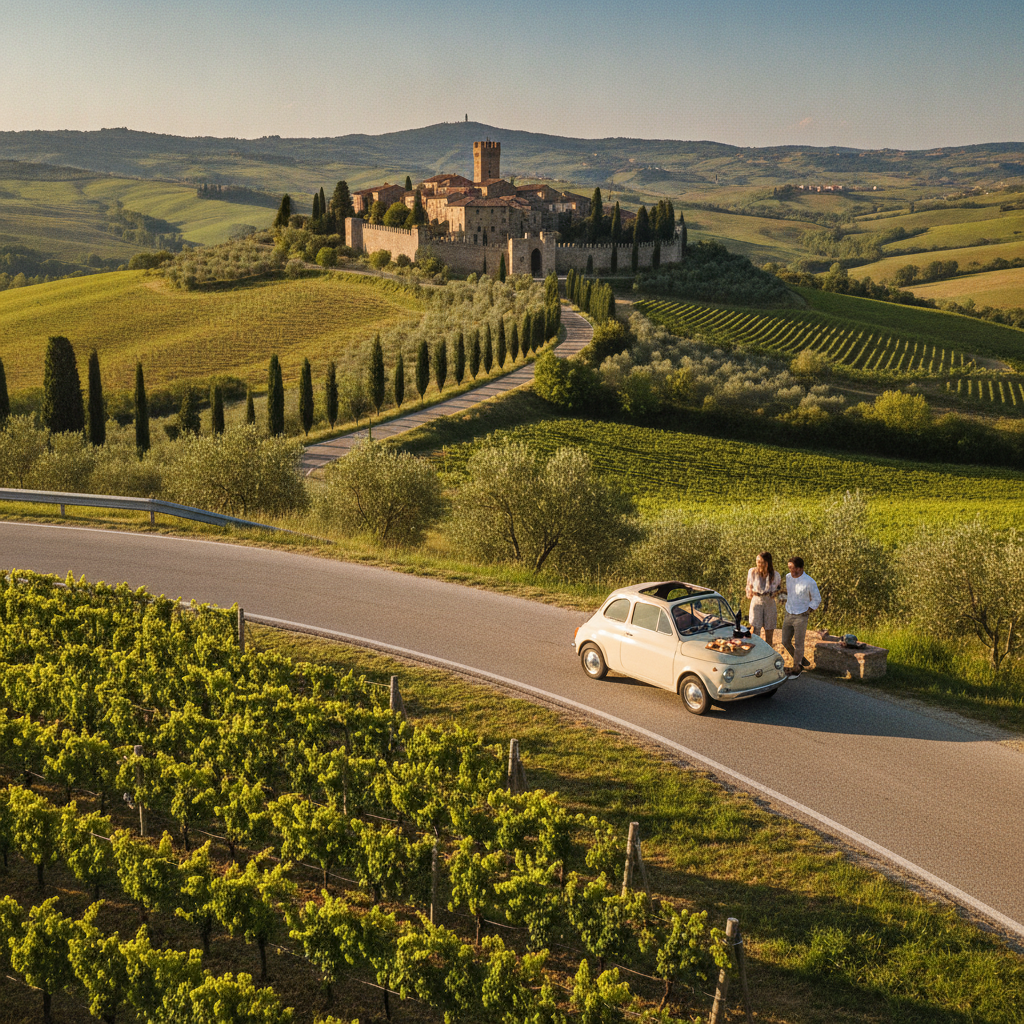
And that setting matters. You feel it as you approach. The village rises above the countryside, compact and self-contained, but never cut off from the land around it. Never Ending Voyage captures that mood with the line, “We are just outside the pretty medieval village…” and that’s exactly the sensation: you’re in rural Tuscany, but with a proper old hill town right there waiting for you.
What should you expect from the visit? Not a wine-only day, unless that’s specifically what you want. The better Montecarlo plan is more balanced. Think medieval streets, a fortress stop, broad countryside views, a relaxed lunch, and then maybe one wine tasting if it fits. A little bit of history, a little bit of scenery, a little bit of appetite. Che figata.
That’s why Montecarlo works so well for couples, families, solo travelers, and friend groups with mixed interests. One person wants photos. One wants lunch. One wants a glass of local white. One just wants a nice walk and no stress. Montecarlo can handle all of that without trying too hard.
First thing. Do not confuse Montecarlo, Tuscany, with Monaco—Monte-Carlo. It happens more than you’d think, especially when people type fast into maps or train search engines and suddenly end up planning a borderline international expedition.
The funniest proof is on Trainline, where the route to Monaco—Monte-Carlo from Lucca is listed at around “8 hours 56 minutes.” If your Montecarlo day trip starts looking like that, stop immediately. Wrong Montecarlo, amico.
The real Montecarlo in Tuscany is a local excursion from Lucca. This is best approached as a short road trip, whether you’re driving yourself, using a taxi, or folding it into a guided outing. The point is simplicity. You’re going for a nearby hill village, not crossing Europe.
When planning, I’d suggest making one basic decision before you set out: half-day or full-day.
If you just want the essentials, go half-day. That means village walk, fortress area, a coffee or light lunch, maybe a quick scenic pause, and back to Lucca. This is ideal if Montecarlo is one stop in a bigger Lucca stay.
If you want the more complete version, go full-day. Then you can explore the center slowly, sit down properly for lunch, and add either one winery stop or a countryside walk without rushing every 20 minutes.
There’s good reason to build the day around the fortress. As Discover Tuscany puts it, “A visit to the small town of Montecarlo will definitely include a stop at the Rocca del Cerruglio.” Definitely. No argument from me.
This part is boring, yes. But useful. Check opening times before leaving Lucca, especially for the Rocca del Cerruglio and any winery you want to visit. Fortress access can vary, and winery visits often work better with a reservation.
Discover Tuscany even flags this directly with its reminder about “Hours to visit the Rocca:” on its Montecarlo itinerary page. So don’t assume. Verify. It takes two minutes and saves you that classic travel annoyance of arriving at a locked gate at 1:15pm.
For wineries, I’d go one step further: if there’s a specific producer you care about, book ahead. Montecarlo may be small, but that’s exactly why schedules can be limited and personal.
Think of Montecarlo as a low-friction day out. Don’t overpack it. This is not the place for twelve pins on a map and a spreadsheet. It’s the place for comfortable shoes, a phone charged for photos, and enough flexibility to stop when you see a view you like.
If you’re comparing options, this is one of the easiest countryside escapes from Lucca. For something with sea air instead, have a look at another easy day trip from Lucca on the Versilia coast.
The core of any Montecarlo visit is simple: walk the medieval center slowly. That’s the experience. Not racing from monument to monument. Not ticking boxes. Just moving through the village, letting the shape of the place do the work.
The center is compact enough that you never feel overwhelmed. Again, dooid Magazine says it well: “The walled, historic center is very tiny and concentrated…” and that’s exactly why it’s so satisfying. You can actually enjoy what you’re seeing instead of spending the whole day navigating.
Enter the old center and just let yourself drift a little. The lanes are the point. Stone underfoot, old buildings close together, little openings toward the countryside, and that nice rhythm you get in a place where people still live real life, not just perform “historic village” for visitors.
Montecarlo has that good hilltop compression. Everything feels close, but never cramped. You can cover the essentials in a couple of hours, but it doesn’t feel rushed because the village reveals itself in small moments: a doorway, a bend in the lane, a sudden view over vineyards.
If there’s one landmark to anchor the visit, it’s the Rocca del Cerruglio. This is the stop that gives Montecarlo its historical backbone and its best sense of position in the landscape.
According to Discover Tuscany, the fortified borgo “was founded in 1333 and guaranteed a prime lookout for Lucca against the troublesome city of Florence.” That date matters. Montecarlo wasn’t randomly perched up there for aesthetics. It was built to watch, defend, and hold ground.
And you feel that when you’re up there. The fortress position makes sense immediately. This is not abstract history on a signboard. The landscape explains it for you.
That’s also where the views hit. TRVBOX describes it perfectly: “The village itself lays on the top of the hill and the view from up there is absolutely breathtaking.” A little dramatic, maybe. But honestly? Fair.
This is not a place to sprint. Montecarlo rewards the slow loop. Walk the walls, pause where the land opens out, and look properly. Vineyards, olive groves, shifting light, little roads threading through the countryside. The whole area has a calm, open feel that balances the tight medieval center.
For photographers, it’s easy money. For everyone else, it’s just a solid excuse to stop and breathe for a minute.
And because the village is compact, you can do this without worrying that you’re “falling behind” on the itinerary. There is no falling behind. The wandering is the itinerary.
Montecarlo is best in clear weather, obviously, because the views are part of the show. But even if the sky turns moody, the village still has atmosphere. The stone lanes, the enclosed streets, the fortress silhouette — it all still works.
If the forecast looks rough and you want a backup plan closer to town, keep this guide to what to do in Lucca if the weather turns handy.
Here’s my honest take: don’t make Montecarlo only about wine unless you are a very serious wine person on a very specific mission. For most travelers, the better day is more balanced. Walk first. Eat well. Then maybe have one tasting, or just a glass with lunch. Basta.
This approach fits the place better. Montecarlo has wine, yes, and good wine too, but it also has village energy, local food, and that broader Lucchesi countryside identity that deserves some space.
dooid Magazine sums up the mix nicely: “You can sip a glass of wine (Colline Lucchesi and Montecarlo DOC), taste the Lucca cuisine…” That’s the move right there. A glass. A meal. A stroll. Not six back-to-back tastings until you forget where you parked.
Keep it local and uncomplicated. Montecarlo is a good place to settle into a relaxed lunch and let the day breathe a little. Think Tuscan dishes, seasonal ingredients, olive oil that tastes like the landscape around you, and wines from the immediate area rather than something shipped in from who knows where.
Montecarlo DOC and Colline Lucchesi wines are the names to know, but you don’t need to become an expert in one afternoon. Order a glass you’re curious about. Ask what pairs well with the house specialties. Let the staff guide you. This is Tuscany, not an exam.
Montecarlo also sits inside a broader local system that connects villages, farms, wineries, and olive oil production. Discover Tuscany’s guide to the wine roads explains that these itineraries, called the Strada del Vino, “propose different routes which basically promote the local of wines (and olive oil).”
That’s useful because it reframes the day. You’re not just visiting a village with some wineries nearby. You’re stepping into a whole agricultural landscape where food, wine, and countryside are tied together.
Visit Tuscany makes it even clearer by noting that local wineries are official stops along the “Strada del Vino delle Colline Lucchesi e di Montecarlo.” So if you do want to add a tasting, it fits naturally into the day rather than feeling bolted on.
The best Montecarlo food stop is one where you’re not watching the clock every five minutes. Sit down. Order properly. Look around. Listen to the room. Locals talking across tables, glasses clinking, a couple sharing antipasti, somebody debating whether to order dessert. That’s the vibe you came for.
Then later, if you’re back in Lucca and still have energy, continue the evening with these aperitivo ideas back in Lucca. Day trip by day, nightlife by night. My kind of planning.
If you want to add wineries, do it smart. One, maybe two stops max. Anything more and the day starts losing its shape. Montecarlo is too nice to reduce it to constant check-ins and tasting pours.
This matters even more when you realize how many options there are. Visit Tuscany notes that “The wine road map counts nearly twenty wineries, a staggering amount in this town of less than 5,000 people.” Nearly twenty. In a place that small. So yes, choice is abundant. That’s exactly why you should be selective.
Pick based on your day, not just the label. If you’re already doing a long lunch, go for one winery in the afternoon. If you’re more interested in scenery than tasting notes, choose a stop with a strong setting and keep the visit short.
And remember, wineries here fit very naturally around the village. As TRVBOX says of one village-fortress stop after a winery visit, “It was about 3 minutes away from the winery.” That’s the beauty of Montecarlo. You’re not spending the whole day in transit.
This is important. Montecarlo is still worth it if you don’t drink. The countryside is part of the attraction on its own. You can drive the local roads, stop for viewpoints, have a long lunch, and enjoy the rhythm of the area without doing a single tasting.
Visit Tuscany highlights this side beautifully, especially with the idea of walking beyond the village. It even points out that “One gorgeous route is the walk to the hamlet of San Martino in Colle.” That’s the kind of detour I love recommending. It gives the day texture.
If you want a nature-oriented pause, the route toward San Martino in Colle is a strong option. It gets you out into the landscape that makes Montecarlo special in the first place: olive groves, vineyards, open views, and quieter corners where the village feels far away even when it isn’t.
There’s also a detail I really like here. Visit Tuscany notes an oak tree near San Martino in Colle that is more than 500 years old. That kind of thing gives the area weight. Not flashy. Just deep-rooted, literally, and very Tuscany.
If this countryside side of Lucca grabs you, keep going with more experiences around Lucca after Montecarlo. There’s a lot beyond the city walls if you know where to look.
Now let’s make it easy. Here’s how I’d structure the day depending on how much time and energy you’ve got. No drama. No overplanning. Just a solid flow that gives you the best of Montecarlo.
This is the version for travelers who want the essentials without giving up the whole day. It works because, as dooid Magazine says, the center is “very tiny and concentrated making it the perfect town to see if you just have a couple of hours.” Exactly.
Arrive in Montecarlo mid to late morning. That gives you good light, a lively village feel, and time to explore before lunch without feeling rushed.
Spend your first hour or so simply walking. Follow the lanes, stop at the viewpoints, and get your bearings. This is where the village wins you over.
Make the fortress your anchor stop. Again, Discover Tuscany is right: “A visit to the small town of Montecarlo will definitely include a stop at the Rocca del Cerruglio.” Check opening hours in advance and build around them.
After the walk and fortress, sit down for lunch. Keep it relaxed. Local dishes, a glass of Montecarlo DOC if you want it, and no pressure to move fast.
After lunch, either return directly to Lucca or make one short scenic stop on the way if the weather is good. This version is compact, satisfying, and very doable.
This is the better choice if you like to travel slower. You keep the village as the core, but you add space for countryside and one extra experience. That’s where Montecarlo really opens up.
Get there in the morning and start with the old center while your energy is high. Walk the lanes first, then head to the fortress and main viewpoints. Take your photos early, before lunch softness kicks in.
Lunch is not a filler here. It’s part of the day. Settle in, eat properly, and enjoy the atmosphere. This is where Montecarlo shifts from “nice village visit” to “yes, this was the right idea.”
If wine interests you, add just one winery in the afternoon. Because the area is dense with producers, you don’t need to drive all over the place. One careful stop is enough to connect the village experience with the surrounding wine landscape.
If you’d rather stay active or skip alcohol, use the afternoon for a walk. Visit Tuscany reminds us that “The Montecarlo area – indeed, all the Lucchesia – is full of opportunities to walk among olive groves and vineyards.” That’s your cue. Head toward San Martino in Colle or take a scenic route through the surrounding countryside.
Wrap up before you get tired of it. That’s the secret. Leave while the day still feels smooth, not when you’ve squeezed every last drop out of it. Montecarlo is best remembered as effortless.
If you ask me, the sweet spot is this: full-day pace, half-day intensity. Meaning you give yourself the whole day, but only plan a few things. Village walk. Rocca. Long lunch. One optional winery or countryside detour. Finito.
That balance is what makes Montecarlo one of the most rewarding escapes from Lucca. You get history, scenery, food, and local character in a format that never feels heavy. For a lot of travelers, that’s exactly the win.
And if you’re building a list of future outings, another strong countryside wellness option is this full-day escape from Lucca to Bagni di Lucca.
Montecarlo is one of those trips that just makes sense. It’s close to Lucca, easy to enjoy, and packed with the kind of things people actually want from Tuscany: a walled hilltop village, big views, real food, and countryside that feels lived-in rather than staged.
The key is not to overcomplicate it. See the medieval center. Go to the Rocca. Eat well. Add one winery stop only if you want it. That’s the formula. A half-day is enough for the essentials, and a full day gives you room to breathe.
So if you’re in Lucca and you want a legit escape without a giant travel production, dai, go to Montecarlo. It’s compact, scenic, and unmissable in the most low-key, high-reward way possible.