This article includes AI generated content (text, images) obtained with Pressnaut. All content has been fact-checked and manually revised by an human editor.
When you step inside the massive Renaissance walls of Lucca, the first thing that hits you isn’t just the history—it’s the aroma. It is the scent of fresh bread baking, the earthy fragrance of rosemary, and the sweet, anise-laced perfume of raisins. While this Tuscan gem is famous for its opera composers and intact fortifications, there is a quieter, tastier revolution happening in its cobblestone streets: the art of street food.
But let’s be clear: when we talk about street food in Lucca, we aren’t talking about greasy fast food chains or rushed, flavorless bites. We are talking about centuries of tradition wrapped in paper napkins. We are talking about “slow fast food”—high-quality, locally sourced ingredients prepared with the patience of a grandmother but served with the speed required by a hungry traveler. Whether you are a foodie hunting for the perfect focaccia or a history buff needing a sugar rush, Lucca offers a culinary landscape that is as rich as its architecture.
To understand the food here, you have to understand the geography. Lucca isn’t just another Tuscan town; it is a crossroads of flavors. As noted by Slow Food Travelers, Lucca is geographically located where you get a blend of food that is unique and not found in many other locations. This specific positioning allows the city to draw on the best ingredients from the coast, the mountains, and the rolling hills of the Tuscan countryside, creating a street food culture that is incredibly diverse yet distinctly local.
The beauty of eating your way through Lucca is the simplicity. In a world that often over-complicates cuisine, Tuscany promises the meal of a lifetime, particularly if you crave fresh ingredients and good, wholesome cooking with no fuss or faff, according to Cellar Tours. This philosophy of “no fuss” is the backbone of the local street food scene. It is about taking a few exceptional ingredients—excellent olive oil, fresh flour, seasonal vegetables—and letting them shine without drowning them in sauces or complex techniques.
Walking through the narrow, winding lanes, you will notice that food here is designed to be mobile. It fits the lifestyle of a city that is best explored on foot or by bike. This accessibility makes the city the perfect base for exploring Tuscany, as you can grab a high-quality bite in minutes before catching a train to Florence or heading out for a day trip to the Garfagnana mountains. The “slow fast food” concept means you don’t have to sacrifice quality for convenience; you get the cultural experience of a sit-down meal in a portable format.
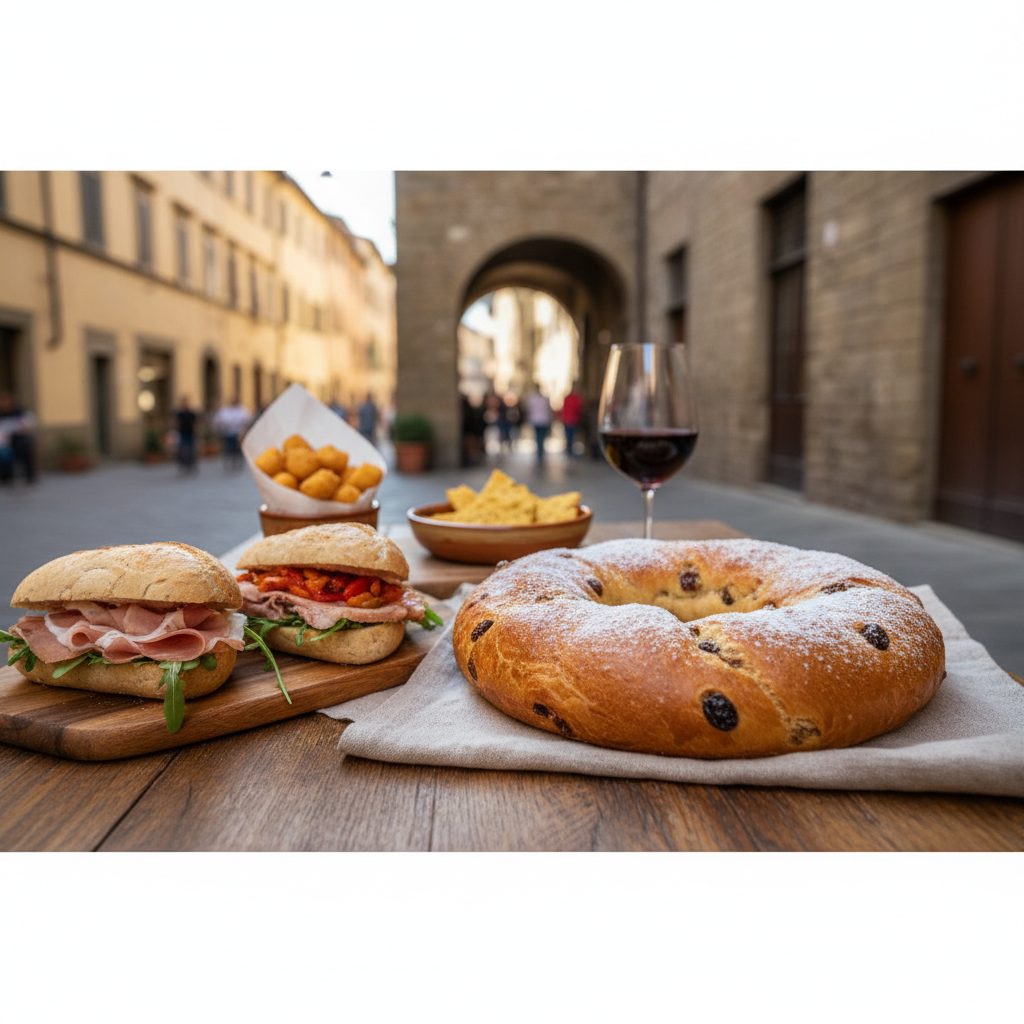
If there is one food item that acts as the edible ambassador of Lucca, it is the Buccellato. You cannot visit this city without seeing these dark, shiny loaves in bakery windows or spotting locals carrying them home for Sunday lunch. But what exactly is it? According to Wikipedia, the Buccellato di Lucca is a sweet bread specific to this region of Tuscany. It is simple, slightly sweet, and packed with raisins and anise seeds, giving it a distinct flavor profile that separates it from standard Italian pastries.
The history of this treat is as fascinating as its taste. The name itself is a nod to the ancient past. Visit Italy explains that the origin of the name ‘buccellato’ is in the Latin word ‘buccella’, which means bite. It seems it was born in Roman times as bread for soldiers. Imagine that: the sweet snack you are enjoying today is the descendant of the rations that fueled the Roman legions. It was designed to be energetic, portable, and durable—the original power bar.
Over the centuries, the Buccellato has evolved, but it hasn’t lost its soul. Juls’ Kitchen reinforces this deep connection to the past, noting that the buccellato is the typical sweet bread of Lucca, whose name dates back to the ancient Roman times. While the shape has shifted from strictly round (resembling a donut or a ciambella) to modern variations that look more like baguettes, the essence remains the same. It is a dense, flavorful bread that demands to be chewed and savored.
This durability and portability make Buccellato the ideal snack for walking the historic walls. There is something poetic about eating a Roman-era bread while strolling atop Renaissance fortifications, looking down at the medieval streets below. It is a culinary timeline in every bite.
While you can find Buccellato in almost every forno (bakery) in town, there is one place that stands above the rest as a guardian of tradition: Buccellato Taddeucci. Located in the heart of the city, this bakery is not just a shop; it is an institution. The history here is palpable.
According to their own history, it was in 1881 that creative Lucca’s baker Jacopo Taddeucci developed Buccellato, and since then, “the old Lucca Buccellato factory” represents the traditional baking art of this city (Buccellato Taddeucci). For over a century, the Taddeucci family has been refining and protecting this recipe, turning a simple soldier’s bread into a masterpiece of ancient and noble traditions.
When you visit Taddeucci, you are tasting a recipe that has survived wars, floods, and changing tastes. The secret lies in the ingredients: flour, sugar, anise seeds, and sourdough yeast. There are no preservatives or artificial flavors here. The result is a product that is fresh, simple, and genuine. It is best eaten fresh on the day it is baked, perhaps with a glass of wine or a coffee, but it toasts beautifully the next day as well.
This hearty, warming sweet bread is particularly delightful if you are visiting Lucca in winter. The spice of the anise and the sweetness of the raisins provide a comforting contrast to the crisp winter air, making it a staple of the holiday season as well as a year-round treat.
After you have satisfied your sweet tooth with a slice of Buccellato, you will likely crave something savory. Lucca’s street food scene excels here as well, offering options that go far beyond the standard tourist sandwiches. The key is knowing where to look to avoid the tourist traps and find the spots where the locals actually eat lunch.
For the absolute best sandwich experience in the city, you need to head to Piazza Napoleone. According to the savvy travelers on the Rick Steves Travel Forum, the best sandwich place is Ciacco on Piazza Napoleone. This isn’t just about slapping ham on bread; Ciacco is famous for its high-quality ingredients and creative combinations. The forum users also note that they serve “salads as big as your head,” making it a fantastic option if you want a break from carbs but still want a quick, substantial meal.
If Ciacco is full—which it often is, given its popularity—don’t worry. The same forum recommends a stellar runner-up: Pan di strada. Located on Corso Giuseppe Garibaldi, this spot offers a more rustic, street-style approach to the panino, perfect for grabbing a bite on the move. Both of these spots embody the “slow fast food” ethos: incredible Tuscan meats, cheeses, and breads, served quickly but without compromising on the quality you would expect from a sit-down meal.
Sometimes, however, only a slice of pizza will do. For travelers on the go who want a quick, hot slice, Postcard Academy recommends La Cranceria. It is the ideal spot for a quick pizza slice that hits the spot without requiring a reservation or a long wait. These savory stops are perfect for lunch, but if you have more time in the evening, you might want to transition from street food to one of the city’s sit-down authentic trattorias to experience the fuller range of Lucchese cuisine.
No culinary tour of an Italian city is complete without addressing the two pillars of Italian daily life: coffee and gelato. In Lucca, these aren’t just afterthoughts; they are rituals. After a day of walking the walls and eating savory focaccia, a caffeine kick or a cool scoop of gelato is mandatory.
For the coffee connoisseur, there is one name that comes up repeatedly. Postcard Academy points to Caffe Santa Zita as the place for coffee. Situated in the historic Piazza San Frediano, this cafe offers an atmosphere that is as rich as its espresso. It is the perfect place to stand at the bar, sip a macchiato, and people-watch for a few minutes before diving back into sightseeing.
And then, there is the gelato. You will find gelaterias on almost every corner, but quality varies. To avoid the piles of brightly colored, artificial gelato, follow the advice from the Rick Steves Travel Forum, which identifies the best gelato spots as Ele (formerly known as De’ Coltelli) and Momo. These shops are renowned for using fresh, seasonal fruit and high-quality milk to create creamy, intense flavors that taste exactly like the main ingredient.
Grab a cone from Ele or Momo and take a stroll. It is the best way to digest your food tour while admiring the architecture. Whether you are heading toward the Roman amphitheater or visiting Lucca’s best museums, a gelato in hand makes the experience that much sweeter. Lucca proves that you don’t need a white tablecloth to eat like a king; you just need an appetite and a good pair of walking shoes.