This article includes AI generated content (text, images) obtained with Pressnaut. All content has been fact-checked and manually revised by an human editor.
If you have ever looked up a travel guide for Lucca, you have undoubtedly seen the same suggestion repeated over and over: “Rent a bike and cycle the walls.” And don’t get me wrong, it is a fantastic experience. Feeling the breeze as you pedal under the shade of centuries-old plane trees is one of the distinct pleasures of Tuscany. But there is a downside to the bicycle. Speed blurs detail. When you are whizzing past locals walking their dogs or navigating around families with strollers, you miss the immense architectural genius beneath your wheels.
To truly understand why Lucca stands as a unique jewel in Italy, you need to slow down. You need to walk. The walls of Lucca are not just a park; they are a complex military machine, a masterpiece of Renaissance engineering that has, ironically, never seen a true siege. By walking, we can stop to admire the brickwork, peer over the edge of the bastions, and even descend into the dark, mysterious tunnels hidden beneath the sunny promenade.
So, put away the bike rental map for a moment. Let’s take a slow-travel deep dive into the history, architecture, and hidden underground passages of the Mura di Lucca.
What we see today is not the first wall to encircle Lucca, nor the second. The massive red-brick structure we enjoy today is actually the “4th circle” of defense. To understand the scale of this project, we have to look back to the early 16th century. This wasn’t a quick renovation; it was a complete overhaul of the city’s identity driven by fear and the rapid advancement of military technology.
According to the Institute and Museum of the History of Science, the construction of the walls was decreed by the Republic of Lucca in 1504. This decision was made to keep pace with progress in military technology, specifically the widespread use of gunpowder and heavy cannons. The tall, thin walls of the Middle Ages were no longer sufficient; they would crumble under cannon fire. Lucca needed something thicker, lower, and stronger.
But why the urgency? The motivation was geopolitical. Lucca was a fiercely independent Republic, but it was surrounded by aggressive powers, most notably Florence. The tension was palpable. As noted by Visit Tuscany, Florence’s dominion in those days stretched as far as Altopascio, just 15 km from Lucca. With the Medici family eyeing their territory from such a short distance, the Lucchesi citizens knew they had to fortify their home or lose their freedom. By 1544, massive renovations were underway to create the impenetrable barrier we see today.
Walking the 4-kilometer perimeter today, it is easy to forget that this park was born out of a desperate need for survival. As you stroll, imagine the anxiety of the 1500s, with enemy troops potentially just a day’s march away. If you want to dive deeper into the local history and see artifacts from this era, you should take some time to discover Lucca’s history at local museums, which house incredible collections that contextulize this period.
When you are on a bike, the wall feels like a continuous loop. But when you walk, you begin to notice the distinct shapes that make up the circuit. The walls are not a perfect circle; they are a series of curtains (the straight parts) and bastions (the arrow-shaped projections). There are eleven bastions in total, and they are the heart of the defensive strategy.
The design was a collaborative effort involving some of the best minds of the time. The renovations were led by Italian and Flemish engineers, who brought different perspectives on fortification. The goal was to eliminate “blind spots.” The shape of the bastions allowed defenders to fire cannons parallel to the walls, protecting the adjacent gates and curtain walls from attackers trying to scale them.
Today, these bastions serve a much more peaceful dual purpose. They act as a formidable historic monument and a beloved green promenade. Each bastion is like a small park unto itself, often planted with specific tree species. As you walk, stop at the Baluardo San Salvatore or the Baluardo San Martino. Look over the edge. You will see the sheer drop and the massive earthworks designed to absorb cannonballs.
Turismo Lucca describes the experience perfectly: this immersive journey allows visitors to discover, from a new perspective, the construction of the bastion walls, their function, and the transformations they have undergone over the centuries. It is a chance to touch the bricks that were laid by hand five hundred years ago. The walls are particularly atmospheric during the colder months when the leaves have fallen, revealing more of the stonework. If you are visiting off-season, you’ll find a quiet magic here; it is worth exploring the walls in winter to see the structure without the summer crowds.
The walls of Lucca effectively turned the city into an island. To enter, you had to pass through specific, heavily guarded checkpoints. Identifying these main historical gates adds a layer of fun to your walk. Originally, there were only three gates, but today there are six, including those added in the 19th and early 20th centuries for modern traffic.
The most impressive is arguably Porta San Pietro. It still retains its original portcullis mechanism and the imposing crest of the Republic “Libertas” above the arch. It was the gate for foreigners, and strict rules applied to who could enter and when. Porta Santa Maria opens to the north, and Porta San Donato to the west. If you are wondering about the specifics, how many gates are there in the walls of Lucca, and what are their names?, the local tourism board provides excellent resources to identify them as you pass overhead.
What makes Lucca so special compared to other Tuscan cities is the state of preservation. As highlighted in a visual tour of the city, Lucca is unique because it is enclosed by its perfectly preserved Renaissance Walls and medieval Towers. Many other cities, like Florence or Bologna, tore down their walls in the 19th century to build ring roads. Lucca kept hers, transforming the military barrier into a social embrace.
Standing on top of Porta San Pietro, you can watch the bustle of the city entering and exiting below while you remain in the peaceful sanctuary of the tree-lined path. It is a lovely contrast. For those driving into the city, these gates are your reference points. It is crucial to know where to leave your car before exploring, so be sure to check a guide on parking near the main gates to avoid restricted traffic zones (ZTL).
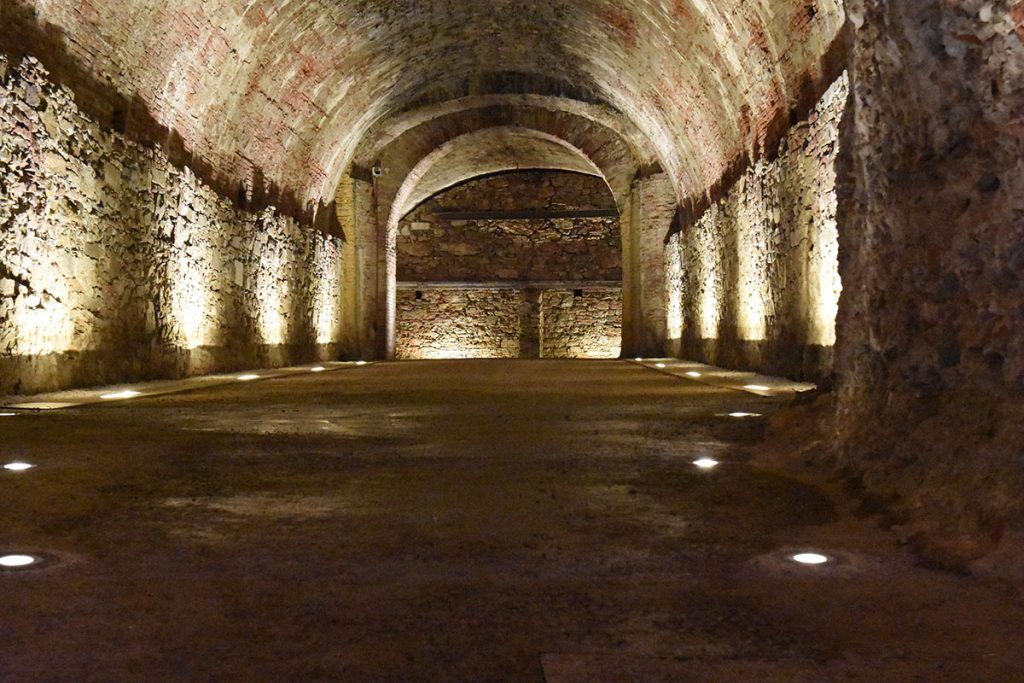
Here is the secret that most cyclists miss entirely. While the top of the walls offers playgrounds, benches, and gelato stands, the interior of the walls hides a mysterious network of tunnels, galleries, and casemates. This is the “belly” of the beast.
The contrast is startling. As described by Two Parts Italy, the walls provide extended green spaces, filled with playgrounds, benches, and statues… Underneath, however, is a much more mysterious place. These areas were designed for soldiers to move unseen, to store ammunition, and to access the sally ports (sortite)—small exits that allowed defenders to sneak out and counter-attack the enemy in the moat.
Stepping into these tunnels, the temperature drops. The air smells of damp earth and old stone. The sounds of the modern city vanish, replaced by the echo of your own footsteps. It is a thrilling experience that connects you directly to the soldiers of the 1500s. You can see the ventilation shafts that lead up to the park above—little grates that you might have walked over without realizing they were the lungs of the fortress below.
This duality is what makes the structure so fascinating. It is, as My Travel in Tuscany puts it, a tale of the walls of Lucca seen from above and below. Above is life, leisure, and light. Below is defense, strategy, and shadow. If you enjoy exploring these kinds of historic fortifications, you might also enjoy a day trip to other fortified Tuscan towns like San Gimignano, though few have a tunnel system as accessible as Lucca’s.
So, how do you get into these underground lairs? Unlike the promenade on top, which is open 24/7 and free to everyone, the underground sections (specifically the restored casemates like those at the Baluardo San Colombano or San Martino) have more restricted access. Some parts are occasionally open for art exhibitions or fairs (like the famous Lucca Comics & Games), but to see the raw historic tunnels, you often need to book a viewing.
Generally, access to the deep underground basements is restricted to groups by appointment. According to Showcaves.com, a resource for underground sites, the tours usually have a specific starting point. Starting point is the Piazzale Verdi, and for a private group experience, the fee is approximately EUR 120 per group. This might seem steep for a solo traveler, but for a family or a group of friends, it is a reasonable price for an exclusive look at history.
For the best experience, it is highly recommended to use authorized guides. They hold the keys—literally and metaphorically—to these spaces. As noted by My Travel in Tuscany, Turislucca is a group of experienced authorized tour guides with a great knowledge of the town. They can explain the difference between a “caponier” and a “ravelin” and tell you stories that aren’t on the placards.
After you emerge from the depths of the Renaissance military complex, you will likely be ready for something a bit lighter. Perhaps a coffee or some retail therapy? You can head straight from the walls to the city center for some shopping along Via Fillungo, appreciating the safety and prosperity that these magnificent walls have guarded for five centuries.
Walking the walls of Lucca is more than just exercise; it is a journey through time. From the fear of a Florentine invasion to the laughter of children playing on the bastions today, the walls tell the story of a city that protected itself so well, it preserved its soul for us to enjoy today.