This article includes AI generated content (text, images) obtained with Pressnaut. All content has been fact-checked and manually revised by an human editor.
When planning a comprehensive itinerary through Tuscany, the default inclination for many travelers is to establish a base in Florence. While the Renaissance capital offers undeniable grandeur, it often comes with the friction of overwhelming crowds, higher price points, and logistical complexities regarding vehicle restrictions. For the discerning traveler prioritizing a “slow travel” philosophy, Lucca emerges not merely as a day-trip destination, but as the superior logistical and atmospheric headquarters for a Tuscan exploration.
Lucca offers a rare convergence of accessibility and tranquility. Unlike the frenetic energy of larger tourist hubs, Lucca operates at a human pace, enclosed within its Renaissance-era walls which serve as a park, a promenade, and a barrier against modern stress. This environment aligns perfectly with the principles of our slow travel guide to Tuscany, encouraging visitors to savor the region rather than rush through it.
Beyond the historic center lies the Piana di Lucca (Plain of Lucca), a geographical feature that distinguishes this area from the rugged, hilly terrain found further south. This landscape facilitates a specific type of engagement with the environment. According to regional tourism guides, the Piana di Lucca is an ideal destination for “active tourism”, defined as a way of experiencing the land by walking, running, or cycling. The flat terrain allows for effortless exploration of historic villas, aqueducts, and rural paths that radiate from the city, offering an immersive experience that is often lost when navigating the congested streets of Florence or the steep inclines of Siena.
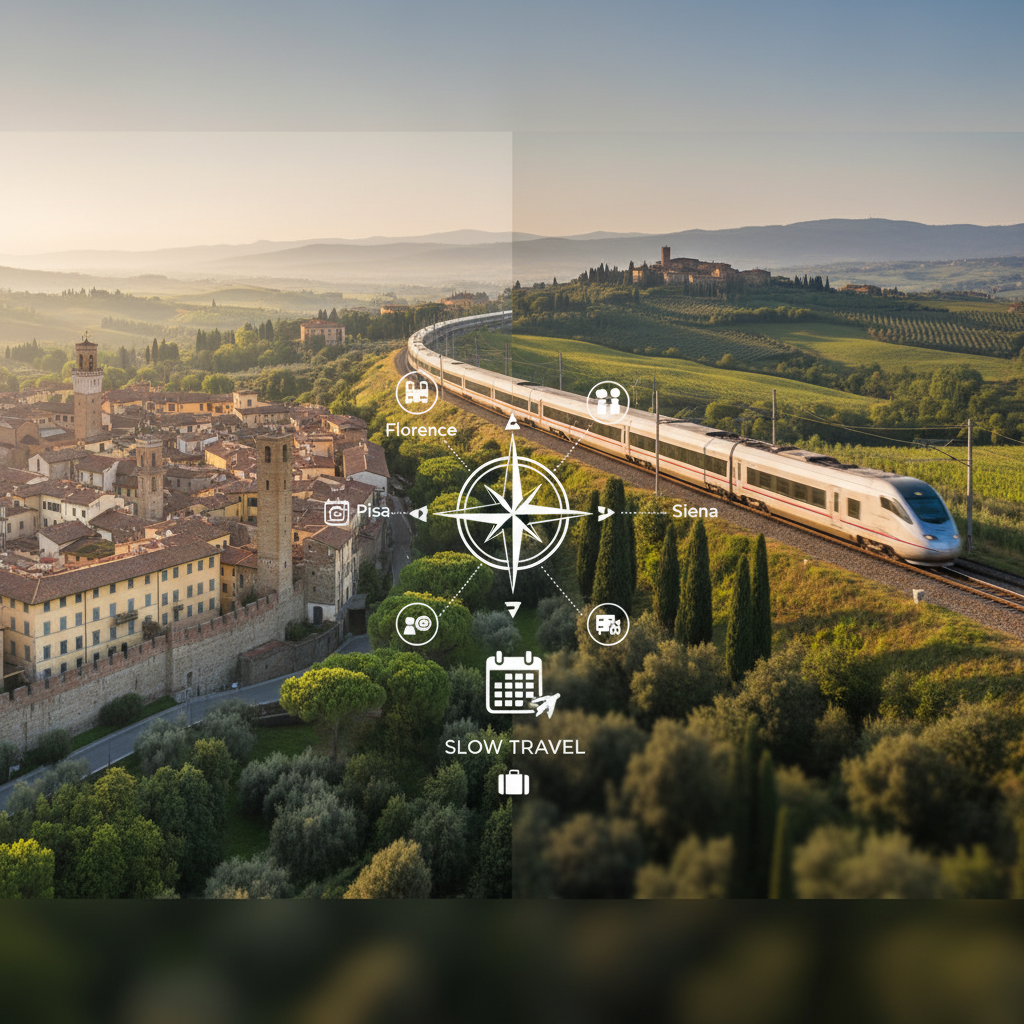
One of the most compelling arguments for choosing Lucca as a base is its exceptional connectivity, particularly for travelers attempting to navigate Italy without a private vehicle. The stress of driving in Italy—navigating ZTL (Limited Traffic Zones), finding parking, and managing narrow roads—can be entirely alleviated by leveraging Lucca’s rail infrastructure.
The geography of the city is particularly favorable for rail travelers. In many Tuscan hill towns, the train station is located in the valley, requiring a bus transfer or a steep hike to reach the historic center. In contrast, Lucca’s station is situated immediately outside the southern walls. While day trippers can easily walk into Lucca’s historic center from the train station, the infrastructure also supports those with luggage, as local buses stop near the station to facilitate transfers to accommodation within the walls. This seamless transition from transit to accommodation is a logistical luxury.
Furthermore, Lucca acts as a pivot point for the region. It is not an isolated outpost but a connected node. For travelers flying into the region, the proximity to major transport hubs is unbeatable. Pisa is only 20 km away, which translates to a travel time of approximately 30 minutes by train. This allows for effortless transfers from Pisa International Airport directly to your accommodation in Lucca, bypassing the need for expensive private transfers or long bus rides. For more detailed advice on managing rail schedules, refer to our guide on navigating Italian trains.
Positioning oneself in Lucca opens up a diverse range of day-trip possibilities that extend beyond the typical rolling hills of wine country. The city’s location in northwestern Tuscany provides unique access to both the Tyrrhenian coast and the Apuan Alps, offering a variety of landscapes within a short radius.
The Cinque Terre is often on the bucket list for travelers to the region, yet staying within the five villages can be logistically difficult due to luggage restrictions and steep terrain. Lucca serves as an excellent staging ground for a day trip to this UNESCO World Heritage site. The best way to get there is by train, via Pisa and then La Spezia. The trains are frequent and easy to use, allowing travelers to reach Riomaggiore, the southernmost village, in reasonable time to hike the coastal paths or enjoy a seafood lunch before returning to the quiet evenings of Lucca. For a detailed itinerary, see our day trip to Cinque Terre guide.
For those seeking relaxation or alpine scenery, Lucca’s rail lines run perpendicular to the coast-inland axis. A short train ride west brings visitors to Viareggio, known for its Liberty-style architecture and expansive sandy beaches. Conversely, heading north introduces travelers to a completely different side of Tuscany. If you love mountains, you can go to Garfagnana, a rugged region of dense forests, fortresses, and distinct culinary traditions that feels worlds away from the manicured cypress alleys of the Val d’Orcia.
While the natural landscape is compelling, Lucca’s strategic value also applies to cultural exploration. The rail line connecting Lucca to Florence stops at several culturally significant yet often overlooked towns. This allows for a deeper dive into Tuscan heritage without the crowds associated with the major capitals.
One such destination is Prato, the second-largest city in Tuscany. Often bypassed by tourists rushing to Florence, Prato offers a rich history of textile production that dates back to the Middle Ages. Prato is close by train and the old town has a charm distinct from its neighbors. Specifically, the textile museum located in an old wool mill is highly regarded and provides context to the region’s economic history that is often missing from standard art-history tours.
For those willing to venture slightly further or utilize a combination of train and bus, the Etruscan hilltop town of Volterra presents another layer of history. Experienced travelers in the region suggest checking trains to Volterra, noting that the town is exceptionally atmospheric. While logistical planning is required, the payoff is access to one of the best-preserved medieval and Etruscan sites in Italy. Travelers interested in these off-the-beaten-path locations should consult our article on lesser-known Tuscan towns.
When selecting a base for a week-long stay, the physical reality of the destination is a factor that is often underestimated until arrival. The romantic image of a hilltop town can quickly clash with the practicalities of daily movement, particularly for families, seniors, or those with mobility concerns.
Lucca’s topography is overwhelmingly flat. This is a significant competitive advantage over popular bases like Montepulciano or Cortona. As noted by travel experts, the Montepulciano hills are no joke; if a traveler cannot handle steep inclines, staying in such a town can transform a relaxing vacation into a physically exhausting ordeal. In Lucca, the entire historic center is accessible, walkable, and cycle-friendly, allowing energy to be spent on sightseeing rather than commuting uphill.
Finally, the standard of accommodation in Lucca and its environs has evolved to meet the demands of the modern luxury traveler. The region has moved past the era where rustic charm excused a lack of comfort. Not long ago, a trip to rural Tuscany was either to rent a villa or stay in a draughty castle that had been converted into a hotel with outdated infrastructure. Today, Lucca hosts sophisticated boutique hotels and renovated historic properties that offer high-end amenities, air conditioning, and concierge services, ensuring that the “slow travel” experience does not require a compromise on comfort. For recommendations on specific properties, review our curated list of best places to stay in Tuscany.