This article includes AI generated content (text, images) obtained with Pressnaut. All content has been fact-checked and manually revised by an human editor.
Close your eyes and think of Tuscany. You’re probably picturing gently rolling hills blanketed in vineyards, rows of cypress trees standing like sentinels along dusty roads, and golden sunlight pouring over medieval hilltop towns. It’s a gorgeous image — and it’s real — but it’s only half of Tuscany.
Now imagine something completely different: jagged mountain peaks dusted with snow, dense chestnut forests so thick the sunlight barely reaches the floor, roaring rivers cutting through deep valleys, and tiny stone villages that feel like they haven’t changed in five hundred years. That’s the Garfagnana — and it’s barely an hour from Lucca.
Known as the “Great Forest” in Italian, the Garfagnana is a steep, densely wooded region pocketed with medieval villages that most tourists never even hear about. While the world flocks to Florence, the Chianti, and the Val d’Orcia, this wild valley quietly carries on being one of the most breathtaking landscapes in all of Italy.
Geographically, it’s a masterpiece. The Garfagnana is crossed in its entirety by the Serchio River, which carves through the valley and nourishes its lush green lowlands. On one side, the dramatic marble peaks of the Apuan Alps rise to the west. On the other, the gentler but equally beautiful Tuscan-Emilian Apennines roll along the northeast. It’s this contrast — verdant valley floor flanked by wild mountains on both sides — that makes the Garfagnana feel like it belongs in a different country altogether.
And here’s the best part: Lucca sits right at the valley’s doorstep, making it the natural gateway for anyone wanting to explore. If you’ve already fallen in love with hidden gems inside Lucca’s city walls, consider this the next chapter in your Tuscan adventure — the one where you trade cobblestones for mountain trails and espresso bars for chestnut-flour crêpes.
One of the things I love most about the Garfagnana is how ridiculously easy it is to reach. You don’t need a complicated plan, an early-morning airport transfer, or a travel agent. You just… go north.
If you have a rental car, this is the most flexible option and — honestly — the most beautiful. You reach the Garfagnana quickly after leaving Lucca, following the Serchio River north up the valley. The road hugs the river and the landscape evolves as you drive. For the first stretch, you’re still in classic Lucca territory — vineyards, olive groves, warm stone houses. But after about 14 miles at Borgo a Mozzano, everything changes. The vineyards disappear, mountains rise on either side, and suddenly you’re in a completely different Tuscany.
The whole drive to Castelnuovo di Garfagnana — the valley’s main town — takes roughly an hour, and it’s the kind of drive where you’ll want to pull over every ten minutes for photos. Driving gives you the freedom to stop at the Devil’s Bridge, detour up to Barga, explore tiny villages on a whim, and generally craft your own adventure.
No car? No problem. The train from Lucca to Castelnuovo di Garfagnana is one of Tuscany’s most underrated journeys. The trip covers 32 km in approximately 1 hour on average, with the fastest services taking just 54 minutes. Even better, there are around 14 trains per day running between the two towns, so you’ve got plenty of flexibility with your schedule.
The train follows the Serchio valley, so you still get those gorgeous mountain views through the window. It’s a particularly great option if you want to focus on Barga and Castelnuovo — both are accessible from train stations — without worrying about parking or navigating mountain roads.
If you love getting around without a car, you might also enjoy Lucca’s river trails, which follow the Serchio south of the city in the opposite direction.
If you’d rather sit back and let a local expert show you around, half-day private tours from Lucca to Barga and the Garfagnana are available. These typically cover the valley’s highlights with a knowledgeable guide who can share stories, history, and restaurant recommendations you’d never find on your own. It’s a great option for solo travelers or anyone short on time.
Drive if you can. The flexibility to stop wherever you like — a roadside chapel, a mountain viewpoint, a tiny village bar — is what makes a Garfagnana day trip magical. But if you’re car-free, the train is genuinely excellent, and you’ll still have one of the best days of your trip.
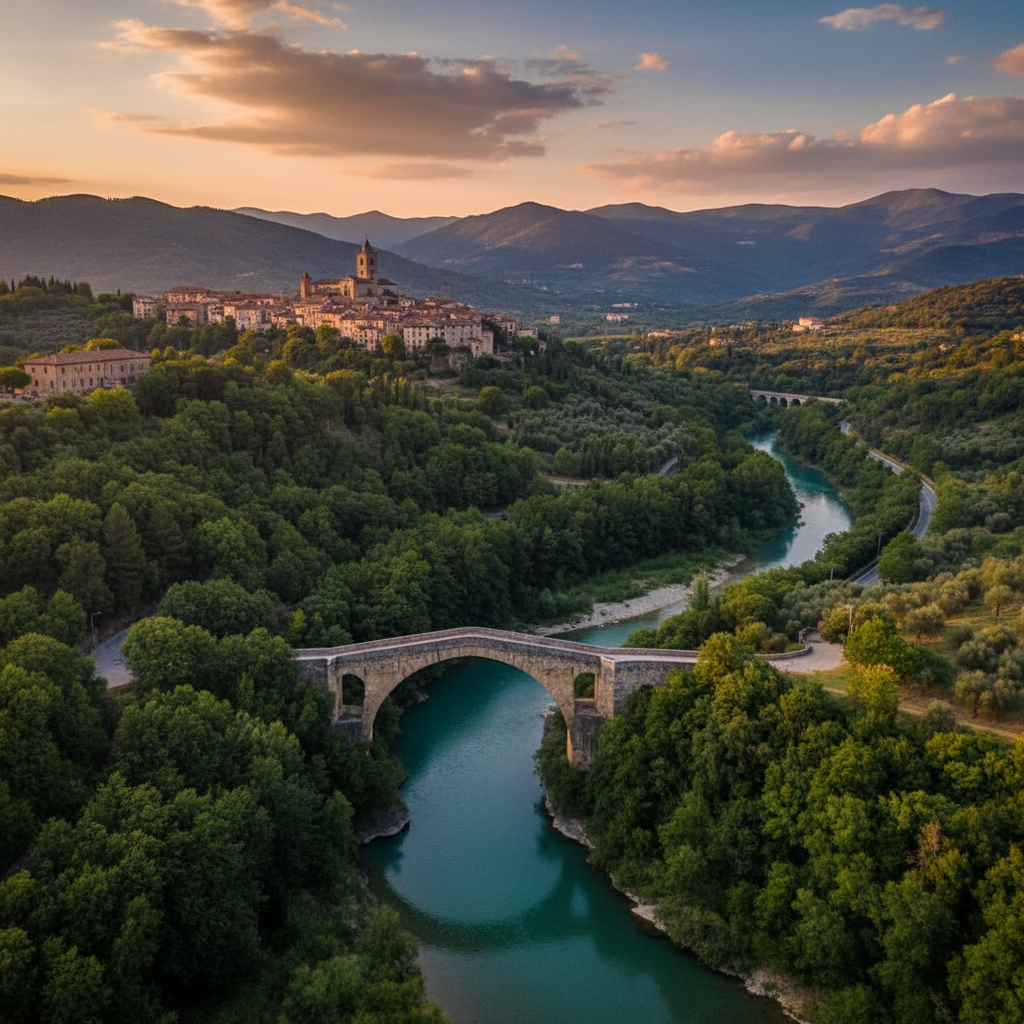
About 14 miles north of Lucca, just as the landscape starts to get interesting, you’ll hit your first can’t-miss stop: the Ponte della Maddalena, better known as the Ponte del Diavolo — the Devil’s Bridge.
And honestly? It looks like something the devil would build. This medieval bridge arches dramatically across the Serchio River in a wildly asymmetrical design — one soaring central arch flanked by smaller ones of varying sizes, the whole thing looking like it was assembled by someone with a flair for the theatrical and absolutely no interest in symmetry. It’s been standing here since at least the 11th century, and it’s one of the most photographed structures in the Garfagnana.
As the story goes, the bridge’s builder was struggling to finish the structure and made a pact with the devil: Satan would complete the bridge overnight in exchange for the first soul to cross it. The builder agreed — then outsmarted the devil by sending a dog across the bridge first. The devil, furious at being tricked, vanished into the river. Whether you believe the legend or not, standing on that impossibly graceful arch with the mountains rising around you, you can understand why people thought something supernatural was involved.
If you love stories like this, you’ll enjoy exploring more of Lucca’s legends and mysteries too — the city has its own share of devilish tales and ancient curiosities.
This is the point where you really notice the scenery has changed — the vineyards and olive groves of the Lucca plain are behind you, replaced by mountains. The Devil’s Bridge is essentially the gateway into the Garfagnana proper, and it makes for a perfect 20-to-30-minute stop: walk across the bridge, take some photos, soak in the views, and then carry on north into the valley.
If the Garfagnana has a crown jewel, it’s Barga. Perched on a hill overlooking the Serchio Valley with the marble-streaked peaks of the Apuan Alps as a backdrop, Barga is the kind of place that makes you want to cancel the rest of your trip and just… stay.
It’s a beautifully preserved medieval town — compact enough to explore in a couple of hours but rich enough to hold your attention for far longer. It’s the featured highlight of most Garfagnana tours from Lucca, and for good reason.
The star of the show is the Duomo di San Cristoforo, a stunning Romanesque cathedral that sits at the very summit of the town. The climb up through narrow stone lanes is half the fun — you’ll pass artisan workshops, quiet piazzas shaded by ancient buildings, and little cafés that seem to exist purely for the pleasure of sitting down with an espresso and staring at the mountains. When you finally reach the Duomo, the panoramic views from the terrace are jaw-dropping: the entire Serchio Valley spreads out below you, framed by the wild mountains that surround the area on every side.
Inside the cathedral, look for the remarkable 12th-century pulpit carved from white marble, decorated with scenes of biblical stories and mythological creatures. It’s a masterpiece of medieval craftsmanship that somehow feels both ancient and alive.
Here’s a fun bit of trivia: Barga has a surprisingly strong connection to Scotland. In the late 19th and early 20th centuries, many Barghigiani emigrated to Scotland to work in the fish-and-chip shop trade. The connection runs so deep that Barga holds an annual “Fish and Chips” festival, and you’ll occasionally hear older residents speaking with a faint Scottish lilt. It’s one of those unexpected cultural crossovers that makes traveling so endlessly interesting.
If you’re visiting in summer, Barga hosts a fantastic jazz festival that draws musicians and music lovers from across Italy and beyond. Imagine sitting in a medieval piazza, the Apuan Alps glowing pink in the sunset, listening to world-class jazz. It doesn’t get much better than that.
Plan for 1.5 to 2 hours in Barga — more if you settle in for a long lunch, which I highly recommend. This is the perfect place to try Garfagnana’s mountain cuisine while gazing at some of the most dramatic scenery in Tuscany.
If Barga is the valley’s beauty queen, Castelnuovo di Garfagnana is its beating heart. This is the Garfagnana’s main town — the administrative center, the commercial hub, and the place where the train from Lucca terminates. It’s less polished than Barga, grittier and more workaday, but that’s exactly what makes it feel so authentic.
The town is dominated by the Rocca Ariostesca, an imposing medieval fortress that gets its name from one of its most famous governors: Ludovico Ariosto, the Renaissance poet who wrote Orlando Furioso, one of the greatest epic poems in Italian literature. Ariosto governed the Garfagnana in the 1520s on behalf of the Este family of Ferrara, and by all accounts, he found the wild mountain valley both beautiful and exasperating. The fortress still stands at the center of town and gives you a tangible connection to a fascinating chapter of Italian literary history.
Castelnuovo’s weekly market is one of the best reasons to visit. Local producers spread their goods across the town’s piazzas: sacks of farro, bags of chestnut flour, wheels of pecorino, jars of wild mushrooms preserved in oil, honey from mountain apiaries, and cured meats you won’t find anywhere else. Even if you don’t hit market day, the town’s small shops stock the same specialties year-round. This is the place to fill your bag with edible souvenirs that actually taste like the Garfagnana.
If you have time and a car, consider pushing further north to Piazza al Serchio, a small town that sits at a fascinating geographic crossroads. This town is a geographical point connecting the Garfagnana area with Emilia Romagna and the Lunigiana, and traces of human habitation here may predate the Romans, with the first concrete evidence dating from Lombard times. It’s not a major tourist destination — and that’s the point. It’s a place where you feel the deep, layered history of this valley in your bones.
Let’s be honest: you can’t visit a place called the “Great Forest” without stretching your legs a bit. The Garfagnana offers some of Tuscany’s finest hiking, sandwiched between two mountain ranges — the rugged Apuan Alps to the west and the rolling Tuscan-Emilian Apennines to the northeast. Whether you’re a serious hiker or just someone who likes a pleasant walk with spectacular views, there’s something here for you.
One of the best things about hiking in the Garfagnana is how well-organized the trail network is. Red and white signs mark all trails very well, so you won’t get lost. This makes the region surprisingly approachable for first-time hikers or anyone who didn’t come to Italy planning to go trekking but got inspired by the mountain views over lunch in Barga.
For a taste of what the Garfagnana’s hiking has to offer, here’s a representative walk that’s perfect for a day trip. Park your car and start on path number 7. The trail climbs gently under the shade of a peaceful beech forest — the kind of dappled, cathedral-like woodland where you can hear nothing but birdsong and your own footsteps. After about an hour’s walk, the forest branches off and you come out in a wide pasture of a bright green color. The contrast is stunning — from the cool, shaded forest to these high, sunlit meadows with mountain views stretching in every direction.
If hiking isn’t your thing — or if you just want a scenic destination to drive to — put Lago di Gramolazzo on your list. Surrounded by green pine trees, this lake will allow you to stay in the Alps without leaving Tuscany. It’s a gorgeous spot: still turquoise water reflecting the mountain peaks above, with picnic areas along the shore. You could easily spend an hour here on a warm afternoon, just soaking it all in.
For a day trip, I’d recommend keeping your hike to 1-2 hours to leave time for the towns and food. A morning walk in the beech forests or an afternoon stroll around Lago di Gramolazzo fits perfectly into a full-day itinerary. But I’ll warn you: once you see the trail maps at a trailhead, with routes climbing up into the Apuan Alps and along ridge lines with views to the sea, you’ll start planning your return trip.
And when you’re back in Lucca that evening, pleasantly tired from all the mountain air, you might want to wind down with a gentle ride along Lucca’s cycling paths along the river and city walls — the perfect flat-terrain counterpoint to a day in the mountains.
Okay, let’s talk about what might be the most compelling reason to visit the Garfagnana: the food.
Forget what you think you know about Tuscan cuisine. The refined olive-oil-drizzled, bistecca-alla-fiorentina, Chianti-sipping Tuscany of restaurant guidebooks? That’s a different world. When you leave behind the vineyards and olive groves of the Lucca plain and enter the mountains, the food changes completely. This is mountain Italian cooking — hearty, rustic, deeply satisfying, and rooted in ingredients that have sustained these communities for centuries.
Zuppa di farro is the signature dish — a thick, warming soup of farro cooked with beans, vegetables, and local olive oil. It sounds simple, and it is, but the quality of the farro elevates it into something special. Order it in any local trattoria and you’ll understand why this grain has been cultivated here since ancient times.
Necci are thin crêpes made from chestnut flour, traditionally cooked between two iron plates over an open fire. They’re typically filled with fresh ricotta and make a wonderful snack or dessert. If you see them on a menu, order them immediately.
Polenta shows up everywhere — creamy, served with ragù, or grilled and topped with wild mushrooms and melted cheese. And the fresh pasta, often hand-rolled and served with slow-cooked meat ragù, is the kind of food that makes you close your eyes and just… be grateful.
I’d recommend planning your lunch as a proper sit-down affair in either Barga or Castelnuovo. In Barga, you’ll find restaurants with mountain-view terraces that turn a meal into an event. In Castelnuovo, the atmosphere is more local and unpretentious — the kind of place where you’re eating next to farmers and shopkeepers, which is exactly what you want.
And when you’re back in Lucca that evening, compare and contrast with Lucca’s own street food scene — a completely different culinary world just an hour south.
Alright, let’s put it all together. Here’s my recommended day trip itinerary that balances sightseeing, eating, and a bit of adventure — whether you’re driving or taking the train.
By car: Head north from Lucca, following the Serchio River north up the valley. The drive itself is part of the experience — watch as the landscape gradually transforms from the gentle Lucca plain into something wilder and more dramatic.
By train: Catch a morning train from Lucca station heading to Castelnuovo di Garfagnana. With around 14 trains per day, you’ve got plenty of options. Grab a coffee at the station and settle in for a scenic hour-long ride.
If you’re driving, pull off at Borgo a Mozzano for a 20-to-30-minute stop at the Devil’s Bridge. Walk across it, take your photos, hear the devil’s footsteps echoing beneath you (okay, that’s just the river), and continue north. Train travelers, you’ll catch a glimpse of the bridge from the train window — wave at the devil as you pass.
Drive or take a short connection to Barga, and spend the late morning exploring this magical hill town. Wander up through the stone lanes to the Duomo, soak in the panoramic views, peek into artisan workshops, and let yourself get a little lost. Barga rewards aimless wandering more than any rigid sightseeing checklist.
Option A: Eat in Barga. Choose a restaurant with a terrace overlooking the valley, order the zuppa di farro and a plate of necci, and take your sweet time. This is Italy — lunch is not a thing to rush.
Option B: Head to Castelnuovo di Garfagnana for a more local, market-town lunch experience. If it’s market day, browse the stalls first and work up an appetite.
This is where you choose your own path:
By car: The drive south back along the Serchio valley takes about an hour. The light in the late afternoon is beautiful — different mountains, different shadows, a completely different mood than the morning drive.
By train: The return journey from Castelnuovo takes about an hour, giving you time to doze, flip through your photos, and start planning your next trip back.
This itinerary works beautifully from spring through autumn. Summer brings the longest days and the warmest weather for hiking, while autumn transforms the chestnut forests into a blazing tapestry of gold and copper. To figure out the best time for your trip overall, check out our guide to the best time to visit Lucca — the same seasonal advice applies to the Garfagnana, with the added bonus that the mountains are always a few degrees cooler than the city on hot summer days.
Here’s the thing about the Garfagnana: it changes your idea of what Tuscany is. Before visiting, you might think of Tuscany as one thing — beautiful, yes, but essentially a landscape of gentle hills and refined living. After a day in the Garfagnana, you realize Tuscany is two places at once: the polished postcard and the wild mountain heart.
The Garfagnana Valley is just one hour from Lucca, but it feels like a different world. The mountains are real mountains. The villages are the kind of places where everyone knows everyone. The food is honest, hearty, and rooted in the earth. And the hiking — through those ancient beech forests, up into bright green mountain pastures, along ridges with views that stretch to the sea — is some of the best in Italy.
You don’t need a car (though it helps). You don’t need to be a serious hiker. You don’t need to speak Italian (though a buongiorno and a smile go a very long way up here). You just need a single day and the willingness to go where most tourists don’t.
Trust me on this one. The Garfagnana is the day trip you didn’t know you needed — and the one you’ll talk about long after you’ve left Tuscany behind.