This article includes AI generated content (text, images) obtained with Pressnaut. All content has been fact-checked and manually revised by an human editor.
If you close your eyes and listen closely to the streets of Lucca, beyond the chatter of tourists and the ringing of bicycle bells, you might just hear the faint, soaring melody of an aria. This isn’t just any Tuscan city; this is the cradle of one of the greatest opera composers the world has ever known: Giacomo Puccini. For music lovers, Lucca is more than a destination—it is a pilgrimage site, a place where the history of opera is etched into the cobblestones.
Exploring Lucca through the lens of Puccini’s life offers a unique way to see the city. You aren’t just looking at old buildings; you are tracing the steps of a genius who transformed the world of music. From the house where he took his first breath to the lakeside villa where he penned his most tragic romances, this guide will take you on a self-guided itinerary in the footsteps of the Maestro.
Every great story has a beginning, and for Giacomo Puccini, that story began in the heart of Lucca’s historic center. Your journey starts at Corte San Lorenzo, n. 8. It was here, in this very building, that the composer was born on December 22, 1858. Today, the apartment has been transformed into the Puccini Museum, a must-visit sanctuary for anyone who cherishes his music.
Walking into the museum feels like stepping back in time. It isn’t just a collection of objects; it is an intimate look at the formation of a legend. The museum preserves the original layout of the house, allowing you to imagine the young Giacomo running through these rooms before he became the toast of the musical world. The collection is extensive, housing documents and memorabilia that paint a vivid picture of his early life and career.
As you wander through the rooms, you’ll find letters, musical scores, and personal items that belonged to the musician. It is fascinating to see the evidence of his early musical training in Lucca, which laid the rigorous foundation for his later studies in Milan. While Lucca is famous for many things, uncovering Lucca’s artisan soul reveals that music was a family trade for the Puccinis long before Giacomo became a household name. This house stands as a testament to that legacy, preserving the memory of the man who would go on to compose La Bohème and Tosca.
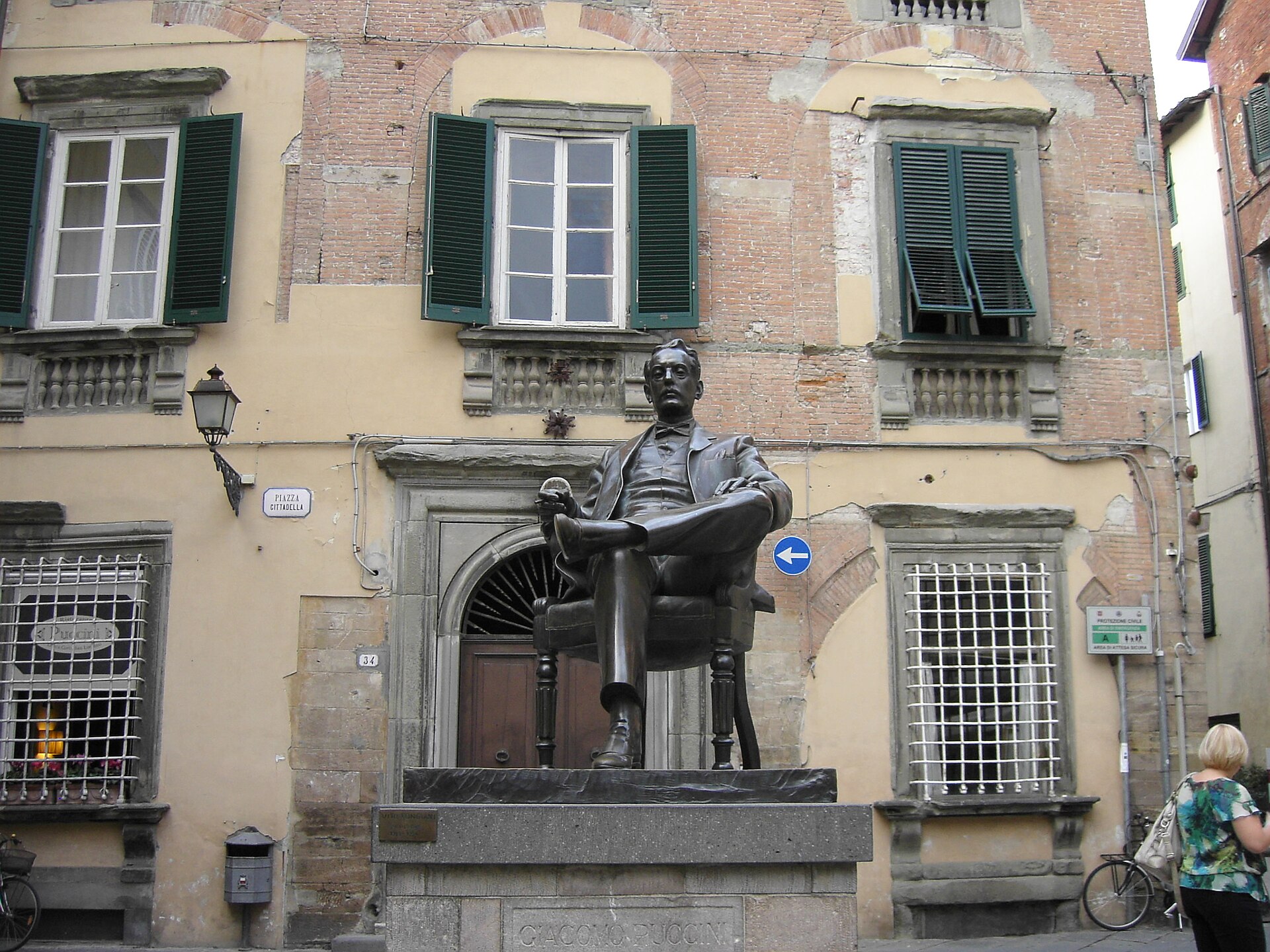
Just a few steps away from the birthplace museum, the atmosphere changes from historical reverence to a celebration of legacy. You will find yourself in Piazza della Cittadella, a charming square that serves as an open-air tribute to the composer. Dominating the space is a magnificent bronze statue of Puccini, capturing him in a relaxed pose, perhaps contemplating his next great melody.
The statue is the work of the artist Vito Tongiani and has become an iconic landmark in the city. It’s a favorite spot for visitors to pause, take a photo, and simply soak in the ambiance. The location is perfect—situated in the San Paolino district, right near his childhood home. According to local itineraries, Piazza della Cittadella is the physical and emotional center of Puccini’s Lucca.
Sitting in this square, you can almost feel the presence of the composer. It serves as a bridge between his private life in the nearby house and his public persona as a giant of Italian opera. It is a place to rest your feet, enjoy the view of the bronze figure, and prepare for the next leg of your musical tour.
No tour of a composer’s life would be complete without visiting the place where music comes alive. In Lucca, that place is the Teatro del Giglio. This theater is not just a venue; it is a survivor of centuries of history and a masterpiece of architecture. Its roots go much deeper than Puccini’s era, adding layers of context to the city’s cultural heritage.
The building itself sits upon a site with a religious past. It was built over the vestiges of an ancient Jesuit monastery. Construction on the theater began in 1672, and it was inaugurated three years later, in 1675. At that time, it was known as the “Teatro Pubblico” (Public Theater), a hub for the city’s social and artistic life. The architect responsible for this grand design was Francesco Buonamici, whose vision helped shape the cultural landscape of the city.
If you are interested in exploring Lucca’s artistic side, the architecture of the Teatro del Giglio is a prime example of the city’s evolution. The transition from a religious site to a secular temple of music mirrors the changing times of the 17th century.
The theater we know today got its current name in the early 19th century. Specifically, it was baptized Teatro del Giglio in 1819. This renaming occurred during the reign of Maria-Luisa, a Spanish Bourbon and the Duchess of Lucca. The “Giglio” (lily) is a symbol often associated with royalty and the city itself, making it a fitting title for the premier opera house.
For Puccini, this theater was significant. While he achieved fame on stages across the world, from Milan to New York, the Teatro del Giglio remains his “home” stage. It is where the locals claimed him as their own, and where his operas are still performed with a special sense of pride. The structure you see today, with its elegant facade and historic interiors, is a direct link to the 1675 inauguration and the subsequent 19th-century renovations that Puccini himself would have recognized.
To truly understand the soul of Puccini, you must venture just outside the city walls. While Lucca was his birthplace, his heart often belonged to a quieter, more natural setting. A short trip from the city center brings you to Torre del Lago, a lakeside retreat that played a crucial role in his creative process.
Here, on the shores of Lake Massaciuccoli, Puccini found the solitude he needed to compose. He lived in what has been described as a relatively modest colonial mansion. This wasn’t a palace of ostentatious wealth, but a sanctuary by the water. Today, this home is the VillaMuseo Puccini, and it is an essential stop for any fan.
Standing by the lake, it is easy to see why he loved this place. The stillness of the water and the rustling of the reeds provided the backdrop for some of the most emotional music ever written. It was here that he composed masterpieces including La Bohème, Tosca, Madama Butterfly, and the unfinished Turandot. The contrast between the bustling streets of Lucca and the serenity of Torre del Lago offers a complete picture of the man—one who thrived on public success but craved private peace.
If you are visiting Lucca with kids, the trip to Torre del Lago is a wonderful addition to your itinerary. The open space near the lake allows for a relaxing break from city walking, and the history is accessible enough to engage younger travelers who might be budding musicians themselves.
Walking the streets and visiting museums is wonderful, but Puccini’s legacy is meant to be heard, not just seen. The culmination of your Puccini tour should undoubtedly be a live performance. There is no better place to experience this than the Teatro del Giglio, located in Piazza del Giglio #13 and #15 in the center of Lucca.
The theater is an intimate venue compared to the massive opera houses of major capitals. With a capacity of 750 spectators, every seat feels close to the action. This intimacy allows for a powerful connection between the performers and the audience, something that Puccini, who was known for his emotional depth, would surely have appreciated.
Attending a concert or an opera here is the perfect way to spend your evening. The cultural scene in Lucca is vibrant, ensuring that the Maestro’s works are kept alive and fresh for new generations. Whether it is a full-scale opera production or a recital of his most famous arias, the music resonates differently when you are sitting in the very city that shaped the composer.
After the final curtain call, the magic continues. Stepping out into the cool Tuscan night after a performance is a feeling like no other. You can enjoy the Lucca after sunset experience, perhaps grabbing a late-night aperitivo and discussing the performance, just as the locals have done for centuries. By following this itinerary, you haven’t just visited Lucca; you have lived a small part of its musical history.