There is a certain magic to discovering Tuscany at a walking pace. While cycling the walls or driving through the vineyards offers one perspective, walking connects you to the earth and history in a way that nothing else can. If you have ever spotted hikers with backpacks and walking sticks wandering through the streets of Lucca, looking slightly weary but incredibly happy, you have likely encountered modern pilgrims on the Via Francigena.
Lucca is not just a beautiful stopover; it is one of the most significant jewels in the crown of this ancient pilgrimage route that stretches from Canterbury to Rome. For centuries, kings, saints, and commoners have passed through our gates, seeking spiritual redemption or simply a safe haven for the night. Today, you don’t need to be religious to appreciate the profound beauty of this journey. Embracing the “slow travel” philosophy by walking a segment of the Francigena is one of the most authentic ways to experience our territory.
In this guide, we are going to trade the wine glasses and shopping bags for comfortable shoes and a sense of adventure. We will explore how Lucca serves as a pivotal crossroads on this historic road, uncover the mysteries of the Volto Santo, and show you how to experience the pilgrim’s life, even if just for a day. Whether you are planning a long-distance trek or just want to understand the spiritual heartbeat of the city, this is a side of Lucca that often goes unnoticed by the casual tourist.
Before we lace up our boots, it helps to understand exactly what we are stepping into. The Via Francigena is not a single road, but a bundle of routes that people used in the Middle Ages to travel from Northern Europe to the Holy See in Rome. It was the internet of the medieval world—a network where culture, commerce, languages, and ideas were exchanged alongside prayers.
In 990 AD, Sigeric, the Archbishop of Canterbury, documented his return journey from Rome, effectively mapping out the official stages we recognize today. Lucca was a major highlight on his itinerary (he referred to it as Luca, stop number XXVI). Why was it so important? Because Lucca was safe within its mighty walls, it was wealthy, and most importantly, it housed a relic that was famous across all of Christendom.
Today, the route is experiencing a massive revival. It appeals to those seeking a digital detox, nature lovers, and history buffs. Unlike the Camino de Santiago in Spain, which can feel crowded, the Tuscan stretch of the Francigena offers moments of profound silence, rolling hills, and intimate encounters with local life.
If you want to experience the thrill of arriving in Lucca on foot, we recommend trying the stage that starts in Camaiore. This is technically “Stage 26” of the Italian route. It is roughly 24 kilometers long, which might sound daunting, but the elevation gain is moderate, and the scenery is absolutely rewarding. It is a perfect day trip if you are staying in Lucca and want to take a bus out to walk back in.
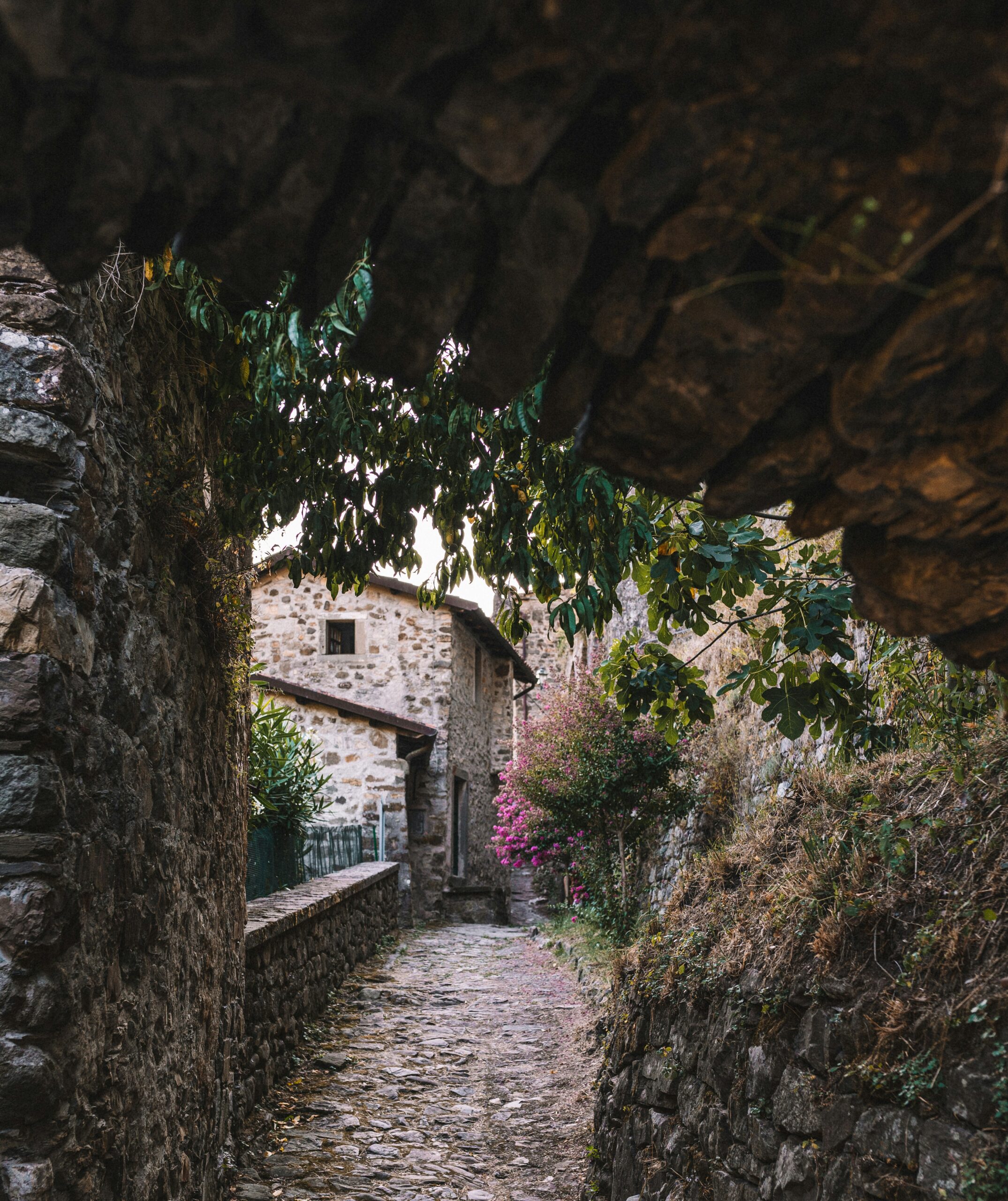
The path winds through the quiet hills of Versilia, passing through ancient villages like Montemagno. As you leave the coast behind, you enter the Valle della Freddana. It is a landscape of olive groves, vineyards, and small streams that feels timeless. The true reward, however, comes at the end. There is a specific emotion attached to seeing the walls of Lucca rise in the distance after hours of walking. You aren’t just a tourist arriving by car; you are earning your entry into the city.
As you approach the city, you will likely enter through the western side. Historically, pilgrims would enter through Porta San Donato. Walking through that dark tunnel of brick and stone into the bright, bustling city center creates a transition that feels almost cinematic. You instantly go from the quiet of the countryside to the lively chatter of a thriving town, just as travelers did a thousand years ago.
Once inside the walls, the Via Francigena doesn’t end; it weaves through the city streets. The destination for every medieval walker was the Cathedral of San Martino. While many visitors flock to the church of San Michele with its soaring facade, San Martino is the spiritual heavyweight of the city.
Before you even enter the cathedral, look closely at the pillars of the portico on the right side. Carved into the stone is a small, intricate finger labyrinth. Beside it, a Latin inscription references the myth of Theseus and the Minotaur. This is one of the great mysteries of Lucca. Why is a pagan symbol on a Catholic cathedral?
“This is the labyrinth built by Dedalus of Crete; all who entered therein were lost, save Theseus, thanks to Ariadne’s thread.”
Scholars believe this was a symbol for the pilgrimage itself: a difficult journey where one could easily get lost (spiritually or physically) without the “thread” of faith. For the weary traveler arriving in the Middle Ages, tracing this finger labyrinth was perhaps a moment of meditation before entering the holy space. It is a small detail, but one that connects you directly to the humans who stood in that exact spot eight centuries ago.
The main reason Lucca became such a vital stop on the Francigena is the Volto Santo, or the “Holy Face.” If you visit the Cathedral of San Martino, you will see a small, octagonal temple (the tempietto) in the left nave. Inside hangs a large wooden crucifix that depicts a dark-skinned Christ, dressed in a tunic rather than a loincloth, with wide, open eyes.
This is not just another piece of church art. Legend says it was carved by Nicodemus, who helped bury Jesus, and that the face was miraculously carved by angels while Nicodemus slept. For centuries, this was considered just a pious legend. However, recent scientific analysis turned the art world upside down.
In 2020, carbon-14 dating confirmed that the wood dates back to the late 8th or early 9th century, making it the oldest surviving wooden statue in the Western world. This isn’t a medieval copy; it is the original artifact that pilgrims traveled thousands of miles to see. Standing before it, you are looking at an object of veneration that Charlemagne’s contemporaries might have worshipped.
For the traveler, the Volto Santo represents the identity of Lucca. It appears on our ancient coins and is the center of our largest festival in September. Understanding this statue explains why Lucca became so wealthy: the flow of pilgrims brought trade, money, and cultural exchange that built the palaces you see today.
If you are feeling energetic and want to continue the journey, the route exits Lucca through Porta Elisa, heading east towards Altopascio. This section is completely flat and easier on the legs, though slightly less scenic than the arrival from Camaiore as it passes through more urbanized areas initially.
However, the destination is fascinating. Altopascio is known historically as the “City of Bread” (and the bread there is truly unsalted and delicious), but in the context of the Francigena, it is famous for the Knights of the Tau. This was a monastic order dedicated solely to protecting and caring for pilgrims. They built a massive hospital (in the medieval sense of a guest house) that was considered one of the best in Europe.
The bell tower in Altopascio, known as La Smarrita, would ring its bell every evening to guide pilgrims who were lost in the foggy marshes that once surrounded the area. Visiting Altopascio today offers a glimpse into the infrastructure of medieval travel. It reminds us that hospitality is a Tuscan tradition that goes back a millennium.
You don’t have to walk to Rome to get a taste of the pilgrim lifestyle. Here is how you can incorporate elements of this slow travel tradition into your stay in Lucca.
The “Credential” is the pilgrim’s passport. It is a folded document where you collect stamps from the places you stay or visit. Even if you are only walking a few kilometers, it is a wonderful souvenir. You can pick one up at the tourist office in Piazzale Verdi or at the entry of the Cathedral Museum. Collecting the stamp from the Cathedral of San Martino is a must-have for any travel diary.
One of the best amenities for walkers in Lucca is the water. The city is dotted with public fountains, and the water is fresh, cold, and perfectly safe to drink. It comes directly from the aquifers in the mountains. Do as the locals (and pilgrims) do: carry a reusable bottle and fill up at fountains like the one in Piazza San Michele or the side of the Cathedral. It is sustainable, free, and tastes better than bottled water.
In the Middle Ages, pilgrims ate simple, hearty food. While we have plenty of Michelin-starred options today, try seeking out a Menu del Pellegrino. Many trattorias along the route offer these set menus for walkers showing a credential. If not, create your own: a slice of buccellato (Lucca’s sweet bread) and a glass of local red wine is the traditional energy boost for travelers in this region.
Timing is everything when you are exploring on foot. Tuscany can get incredibly hot in July and August, making the road from Camaiore or the path to Altopascio grueling rather than enjoyable.
After a long day of walking, whether you have trekked 20 kilometers or just wandered the cobblestones of the center, the concept of “home” becomes very important. The medieval pilgrims slept in large communal halls, but luckily, standards have improved!
Staying in an apartment within the walls allows you to experience the city when the day-trippers have left. There is a specific quietness in Lucca at night that is conducive to rest and reflection. When you wake up in a Flat in Town apartment, open the shutters, and hear the church bells ringing, you are participating in a morning ritual that has greeted travelers for centuries.
In a world of fast flights and checklist tourism, the Via Francigena invites us to slow down. It teaches us to look at the details—the carving on a column, the shade of a cypress tree, the taste of bread. Lucca is a city that reveals its secrets only to those who take the time to look.
By walking even a small part of this ancient road, you are not just visiting Tuscany; you are connecting with the millions of souls who have passed this way before you. You are becoming part of the story. So, pack your comfortable shoes. The road is waiting.