This article includes AI generated content (text, images) obtained with Pressnaut. All content has been fact-checked and manually revised by an human editor.
When planning a trip to Tuscany, the urge to see everything is strong. You want the rolling hills, the historic art, the famous wine, and, of course, the iconic landmarks. However, the reality of moving hotels every night can turn a dream vacation into a logistical marathon. This is where Lucca shines as a strategic home base. Unlike the hustle and bustle of larger tourist hubs, Lucca offers a sense of calm and containment within its Renaissance walls.
Many travelers feel compelled to stay in Pisa to see the Leaning Tower, but the atmosphere there can be quite different from the relaxed charm of Lucca. Pisa, particularly around the Square of Miracles, buzzes with a high-energy, tourist-heavy vibe. In contrast, Lucca feels like a living room—a place where locals ride bicycles slowly, and the evening passeggiata is a sacred ritual. By basing yourself in Lucca, you get the best of both worlds: a peaceful sanctuary to wake up in and easy access to the region’s highlights.
The beauty of visiting Pisa from Lucca is that it doesn’t require a massive commitment. You don’t need to pack your bags or check out of your hotel. As noted by travel experts, Pisa is totally doable in a day. In fact, you can easily visit the famous Leaning Tower and explore everything there is to do in the Piazza dei Miracoli in just a morning or afternoon. This leaves the rest of your day open for a perfect slow travel itinerary back in Lucca, enjoying a gelato on the walls or exploring the botanical gardens.
Choosing Lucca as your hub removes the stress of travel. You aren’t rushing to catch a connection with all your luggage; you are simply taking a leisurely excursion. It allows you to tick a major bucket-list item—the Leaning Tower—off your list without sacrificing the authentic, slow-paced Tuscan experience that Lucca provides.
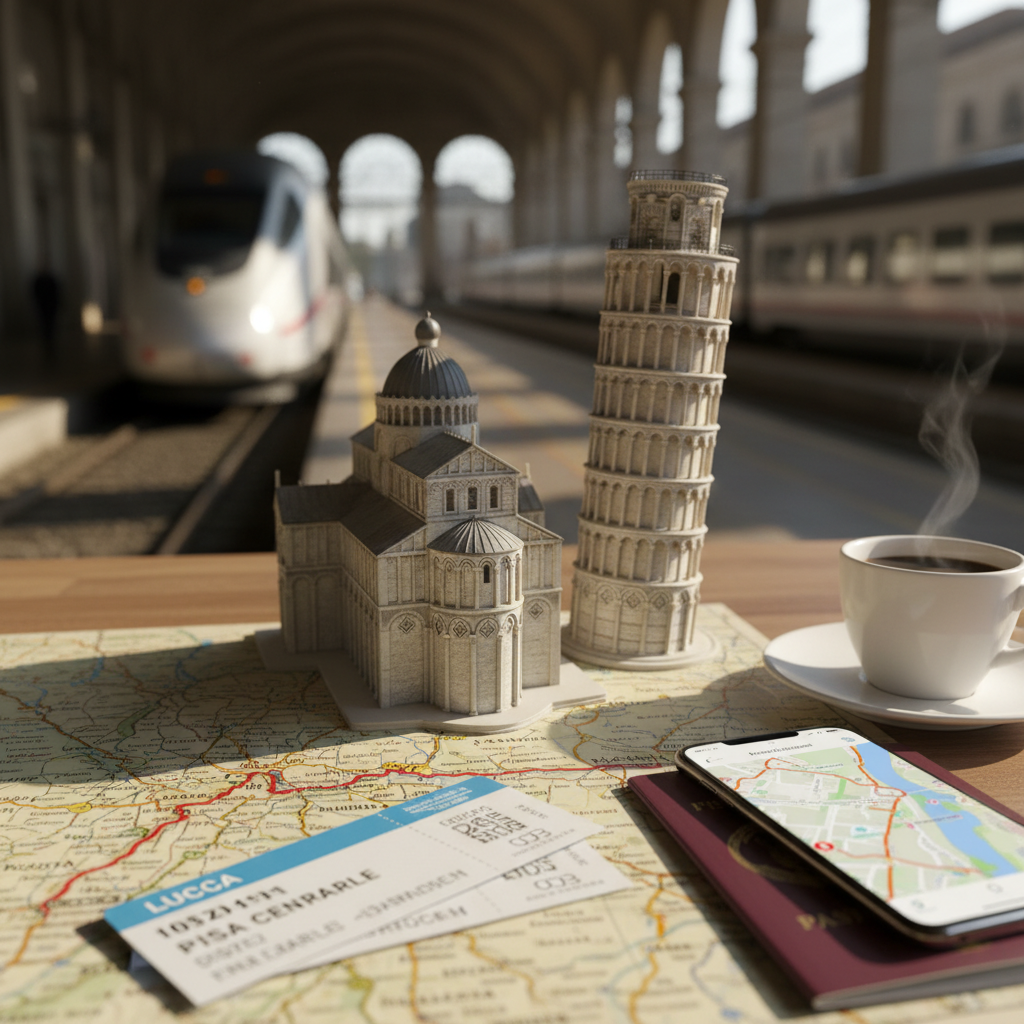
One of the main reasons we recommend this day trip is the sheer convenience of the train connection. Forget about renting a car, navigating ZTL (limited traffic) zones, or hunting for expensive parking spots. The train system in this part of Italy is efficient, frequent, and incredibly affordable.
The journey is surprisingly short. Depending on which train you catch, you can expect the journey from Lucca to Pisa by train to take around 40 minutes. However, if you catch one of the faster regional connections, it can take as little as 20 minutes. This is barely enough time to finish a cappuccino! This proximity means you could technically decide to go to Pisa on a whim over breakfast and be standing in front of the Leaning Tower before lunch.
Budget-conscious travelers will also appreciate the cost. Tickets are very wallet-friendly, often starting around €5.00 (or approximately $4.84). This makes it one of the most cost-effective excursions you can take in the region. You simply buy your ticket at the station or online, validate it at the green machines (if you have a paper ticket), and hop on.
Beyond the practicality, the ride itself is a lovely introduction to the landscape. As you travel between these two historic cities, the route offers spectacular views of the Tuscan countryside. You will glide past rolling fields, rustic farmhouses, and the distant hills that make this region famous. It turns the transit time into a sightseeing opportunity, allowing you to relax and watch Tuscany roll by your window.
Arriving at Pisa Centrale station places you on the southern edge of the city center, while the famous tower is located to the north. Don’t let this deter you; the walk is part of the experience and allows you to see the \”real\” Pisa before you hit the tourist epicenter.
When you step out of the train station, you won’t immediately see the Leaning Tower. Instead, the first thing you see is Piazza Vittorio Emanuele. This is a grand, amphitheater-shaped square surrounded by a circular, fully pedestrian open gallery. It is a bustling hub of modern life, often filled with students and locals going about their day. It sets the stage for a walk that transitions from modern Italy to the Middle Ages.
From here, you will head north along Corso Italia. This is the main shopping street of Pisa, lined with boutiques, cafes, and bookstores. It is entirely pedestrianized, making for a stress-free stroll. As you walk, you’ll feel the energy of the city. It’s vibrant and authentic, a stark contrast to the singular focus of the Square of Miracles. This walk usually takes about 20 to 30 minutes, but it passes quickly as there is plenty to look at. You will eventually cross the Arno River, which offers stunning views, before diving into the medieval streets that lead you toward the tower.
Eventually, the narrow streets open up, and you are greeted by a sight that is truly breathtaking: the Piazza dei Miracoli, or Square of Miracles. The lush green lawn contrasts sharply with the gleaming white marble of the monuments, creating a visual impact that photos simply cannot capture. This UNESCO World Heritage site is home to four major religious edifices: the Cathedral (Duomo), the Baptistery, the Campanile (the famous Leaning Tower), and the Camposanto Monumentale (cemetery).
While the Leaning Tower gets all the fame, the artistic value of the entire complex is staggering. The architecture is a unique blend of Islamic, Byzantine, and Classical influences known as Pisan Romanesque. If you look closely at the details, you’ll see the work of masters. The extraordinary sculptural work inside and out is by the unmatched 13th-century father and son team Nicolo and Giovanni Pisano. Their Gothic displays and intricate pulpits revolutionized sculpture in Italy, paving the way for the Renaissance.
For those interested in the artisan soul of Tuscany, the craftsmanship visible on the Cathedral’s facade is mesmerizing. The intricate geometric patterns and the sheer scale of the bronze doors are worth stopping to admire.
You might be wondering how much time to budget for this. Despite its global fame, the area is surprisingly compact. This site is not huge, so it’s easy to explore in an hour or two. If you plan to climb the tower (which requires a pre-booked ticket) or visit the interior of the Baptistery to hear its famous acoustics, lean toward the two-hour mark. However, if you are content to admire the architecture from the outside and take a few fun perspective photos, one hour is plenty. This efficiency is exactly what makes the day trip from Lucca so appealing.
Once you have marveled at the Square of Miracles, avoid the mistake that most day-trippers make: heading straight back to the train station. Pisa has much more to offer than just its tilted bell tower. To truly appreciate the city, you need to step away from the souvenir stalls and explore the historic center.
We highly recommend making your way back toward the river, but perhaps taking a different route through the winding medieval streets. Take a stroll along the Arno River as well as get lost in the quaint streets of the city centre. The area around Piazza dei Cavalieri, once the political heart of medieval Pisa and now home to the prestigious Scuola Normale Superiore, is stunning and far less crowded.
The riverfront, known as the Lungarno, is particularly beautiful. A stroll along the Arno River is an absolute must do when visiting Pisa. Here, you can take in some of the city’s beautiful Renaissance architecture reflected in the water. The palaces lining the river are colorful and grand, reminiscent of Florence but with a distinct Pisan character. It’s a peaceful place to walk, watch the sunset, or enjoy a gelato.
Exploring these streets also gives you a connection to the region’s broader cultural history. Just as Lucca celebrates its musical heritage through Puccini, Pisa has a rich intellectual history as the university town of Galileo Galilei. Walking these streets feels like walking through history, where every corner reveals a new church, a hidden square, or a centuries-old cafe.
After a few hours of exploration, the short train ride back to Lucca feels like a breeze. Knowing that your return journey is only 20 to 40 minutes long removes the anxiety often associated with day trips. You don’t have to dread a long commute; you’ll be back “home” before you know it.
Upon returning, you are just in time to enjoy the evening atmosphere of Lucca. The city transforms at night; the walls are illuminated, and the piazzas fill with locals enjoying the cool air. Plus, with that extra night, you can enjoy a relaxed dinner at one of Lucca’s renowned trattorias. You can recount the day’s adventures over a plate of tordelli lucchesi and a glass of local red wine.
This half-day itinerary perfectly balances the \”must-see\” tourism of Pisa with the \”must-feel\” relaxation of Lucca. It allows you to maximize your time in Tuscany without burning out. Whether you end your night with a quiet stroll or dive into our guide to aperitivo and nightlife, you’ll go to bed knowing you made the most of your day.