If you think Lucca is just a quiet, medieval town where people whisper in libraries and sip tea behind ancient walls, you are in for a magnificent surprise. While it is true that our beloved city has a relaxing, slow-paced soul, it also possesses an alter ego that is vibrant, loud, and incredibly international. Throughout the year, Lucca transforms its historic piazzas and massive defensive walls into stages for some of the most spectacular events in Europe.
Living here, we see the city change its skin with the seasons. One month, the air smells of camellias and wet earth; the next, the streets are vibrating with the bass of a Rolling Stones concert; and before you know it, you are sharing your morning espresso with a Stormtrooper or a medieval elf. This dynamic calendar is exactly why Lucca is not just a place to visit once, but a destination to return to, time and time again.
While many guidebooks tell you about the architecture and the food, few explain how to navigate the social calendar like a local. Whether you are a music lover, a pop-culture geek, a gardening enthusiast, or a fan of deep-rooted religious traditions, there is a week in Lucca with your name on it. In this guide, we are going to walk you through the major events that define our year, offering you practical tips on how to survive the crowds, where to buy tickets, and how to enjoy the festivities from the perspective of a true Lucchese.
After the quiet introspection of winter, Lucca wakes up with an explosion of color. Spring here isn’t just about better weather; it is about celebrating nature. The city has a deep connection with botany and gardening, dating back to the noble families who competed to have the most exotic gardens in their villas.
Usually kicking off in late March or early April, VerdeMura is the first sign that the season has turned. Imagine this: the historic city walls, usually a place for jogging and cycling, are lined with hundreds of stalls featuring rare plants, bulbs, and gardening tools. It focuses specifically on outdoor gardening and seasonal blooms.
It is not just a market; it is an exhibition. You will find experts giving workshops on how to prune roses or care for citrus trees. If you are staying in one of our apartments with a terrace, this is the perfect place to pick up a small lemon tree or some aromatic herbs to make your temporary home smell like Tuscany.
While technically held in the nearby villages of Pieve and Sant’Andrea di Compito (a very short drive from the city center), the Exhibition of Ancient Camellias is a staple of the Lucchese spring. This area is known as the “Borgo delle Camelie.” During March, the private gardens of historic villas open their gates to the public, revealing camellia trees that are hundreds of years old. It is a slow, romantic event, perfect for photography enthusiasts and those looking to escape the noise of modern life.
In late April, we celebrate Santa Zita, one of Lucca’s patron saints (and yes, we have a few). Legend says she turned bread into flowers to hide her charity from a harsh employer. To honor her, Piazza dell’Anfiteatro—the oval plaza that was once a Roman arena—is completely filled with flower stalls. It is a breathtaking sight. The contrast of the yellow, pink, and red petals against the medieval yellow buildings of the piazza is iconic. It is a local tradition to buy a bouquet of daffodils here for good luck.
As the temperatures rise, so does the volume. Summer in Lucca is defined by one massive entity: The Lucca Summer Festival. However, there is also a classical counterpoint that keeps the city’s heritage alive.
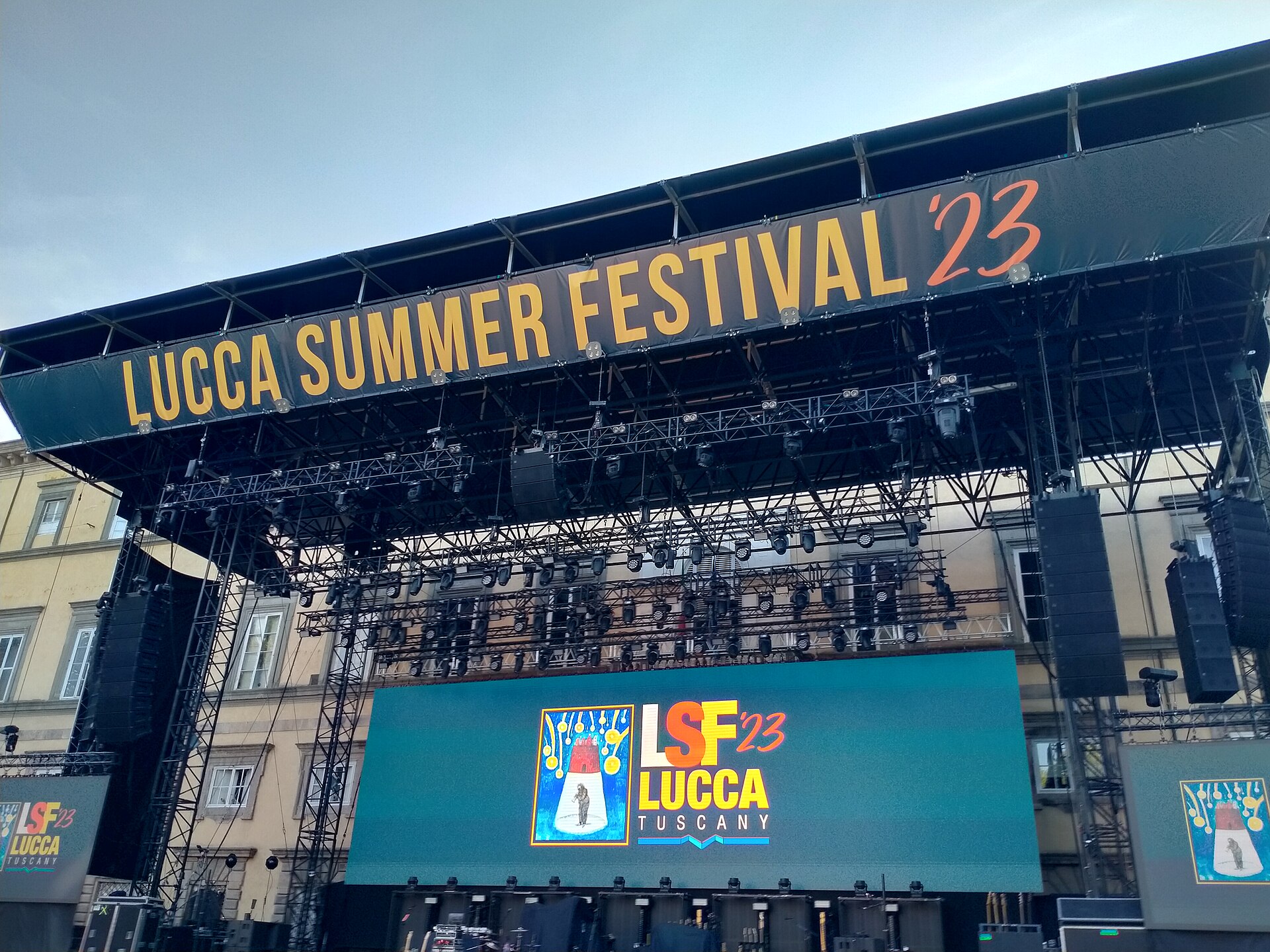
If you tell an Italian you are going to Lucca in July, they will immediately ask: “Who are you going to see?” Since 1998, the Lucca Summer Festival has brought the biggest names in music history to perform inside the city walls. We are talking about legends like The Rolling Stones, Elton John, David Bowie, Bob Dylan, and modern icons like Ed Sheeran and Justin Bieber.
The main stage is usually set up in Piazza Napoleone. The experience is surreal; you are watching a world-class light and sound show surrounded by the Ducal Palace and ancient sycamore trees. For massive acts (like the Rolling Stones), the stage moves to the field outside the walls to accommodate tens of thousands of people.
Local tip: If you are visiting during July, accommodation books up months in advance. If you don’t have a ticket but want to soak up the atmosphere, the bars surrounding Piazza Napoleone often let you hear the music perfectly, even if you can’t see the stage. Just be prepared for crowds.
For those who find rock concerts a bit too chaotic, the Lucca Classica Music Festival usually happens earlier in the summer. It turns the entire city into an auditorium. You might stumble upon a string quartet playing in a church cloister, a piano solo in a noble palazzo, or a cello performance under the loggia of the Praetorian Palace. It celebrates Lucca’s history as the birthplace of composers like Boccherini and Puccini, blending high culture with the casual atmosphere of a summer stroll.
Ask any local, and they will tell you: September is the “real” Lucca. This is when the Settembre Lucchese takes place, a month-long celebration of our identity, mixing religious devotion with agricultural fairs and funfairs.
Mark this date: September 13th. If you can only witness one event in Lucca in your lifetime, let it be the Luminara. This is the procession of the Holy Cross (Santa Croce).
On this night, all electric lights in the historic center are turned off. The city is illuminated solely by thousands of small candles (lumini) attached to the facades of buildings, tracing the architectural lines of windows, doors, and cornices. A solemn procession moves from the Basilica of San Frediano to the Cathedral of San Martino, carrying the “Volto Santo” (Holy Face), an ancient wooden crucifix.
The atmosphere is mystical. The flickering candlelight, the sound of choirs, and the smell of wax create a time-travel effect. The night ends with a spectacular fireworks display visible from the walls. It is not a tourist show; it is a deeply felt ritual for the Lucchese people.
Usually held in early September, Murabilia is the big sister to spring’s VerdeMura. Located on the walls between Baluardo San Regolo and Baluardo La Libertà, it is one of the most important gardening exhibitions in Italy. The focus here is often on orchids, pumpkins, and autumn plants. It is a fantastic place to wander, even if you aren’t buying, just to see the incredible displays and the “heaviest pumpkin” competitions.
October brings a change in the air, and by the end of the month, Lucca undergoes its most radical transformation. The medieval stone meets modern pop culture in a collision that is colorful, chaotic, and absolutely unique.
This is the big one. Lucca Comics & Games is the largest comic book, gaming, and fantasy convention in Europe, and second in the world only to Comiket in Tokyo. It usually runs for five days spanning late October and early November (around All Saints’ Day).
Unlike other conventions held in sterile convention centers, this festival takes over the entire historic city. Huge pavilions are erected in the piazzas. The city walls become a runway for thousands of cosplayers. You will see Game of Thrones characters ordering gelato, Marvel superheroes walking the ramparts, and manga characters taking selfies in front of San Michele.
The energy is infectious, but it requires strategy:
Even if you aren’t a “nerd,” seeing the medieval city invaded by this wave of creativity is a bucket-list experience. Just be prepared for very large crowds and long lines at restaurants.
Once the chaos of Comics subsides, Lucca settles into a cozy, festive rhythm. Winter is arguably the most underrated time to visit. The streets are quieter, the food is heartier (hello, tordelli and red wine), and the city dresses up in elegant lights.
Giacomo Puccini was born in Lucca on December 22, 1858. Every winter, the city honors its most famous son with Puccini Days, a festival running from late November to late December. The program includes concerts, operas, and conferences. It is a sophisticated way to enjoy the colder evenings, culminating in a special concert on his birthday.
In recent years, Lucca has stepped up its Christmas game. The “Lucca Magico Natale” transforms the city with artistic light installations. Unlike the flashy lights of big metropolises, Lucca’s illuminations are designed to highlight the architecture. Piazza San Michele usually features a massive tree, and there is often a traditional Christmas market in Piazza Napoleone, complete with an ice skating rink.
New Year’s Eve (Capodanno) is celebrated in the piazza with free concerts and fireworks, a joyful community gathering where corks are popped collectively at midnight.
Visiting Lucca during a major event is thrilling, but it requires a different approach than a standard relaxing holiday. Here is how to make it work for you.
If you love crowds and energy, aim for July (Summer Festival) or late October (Comics). If you want the “real” Lucca with a touch of magic, go for mid-September (Santa Croce). If you want peace, quiet, and flowers, aim for April (but check the dates for Easter, which can also be busy).
During the Summer Festival and especially Lucca Comics, prices for accommodation can double or triple. The key is to book directly and early. Staying within the walls (centro storico) during these events puts you in the heart of the action, which is convenient but noisy. If you want a retreat after the concert, look for properties just outside the walls—you are still a 10-minute walk from the fun, but you will sleep better.
Lucca has an incredible food scene, but during festival weeks, walking into a trattoria at 8:00 PM without a reservation is a recipe for starvation. During Comics and the Summer Festival, book your tables weeks in advance. Alternatively, embrace the street food culture: grab a slice of cecìna (chickpea flatbread) or a focaccia and eat on the walls while watching the sunset.
Summer concerts can be hot and humid; dress lightly. The Comics festival in late October is notoriously rainy—it is almost a tradition. If you are coming for Comics, bring waterproof boots and a poncho. The Luminara in September usually enjoys perfect, crisp late-summer evenings.
You might wonder, “Why not just visit when it’s quiet?” You certainly can, and Lucca is beautiful in its silence. But these festivals are the heartbeat of the city. They are when the ancient stones interact with the living present. Seeing a modern art installation against a Romanesque church, or hearing rock music bounce off Renaissance walls, reminds us that Lucca isn’t a museum piece—it is a living, breathing city that loves to celebrate.
So, check your calendar, pick your passion, and come join the party. Whether you are lighting a candle for the Holy Face or singing along to your favorite band, you will be part of a tradition that keeps Lucca forever young.