If you have ever looked at a panoramic photo of Lucca taken from above—perhaps from the top of the Guinigi Tower—you noticed one thing immediately. Amidst the sea of terracotta rooftops, there are bell towers everywhere. And I mean everywhere. They say Lucca is the “City of 100 Churches,” and while that might sound like a marketing exaggeration, historically, it isn’t far from the truth. In the Middle Ages and the Renaissance, building a church here was the ultimate status symbol for wealthy merchant families, leading to a density of sacred spaces that is almost unmatched in Tuscany.
But let’s be honest: unless you are a devout historian or an architecture student, the idea of visiting one hundred churches sounds exhausting. You came to Lucca to relax, eat some tordelli, and enjoy the dolce vita, not to write a thesis on Romanesque facades. That is exactly why you need a curated approach. You don’t need to see them all; you just need to know which ones hold the best secrets.
In this guide, we are going to walk past the obvious tourist snapshots and dive into the legends, the hidden art, and the underground layers of Lucca’s sacred architecture. From mummified saints to hidden labyrinths, here is how to explore the spiritual side of the city without getting “church fatigue.”
You cannot talk about Lucca without mentioning the heavy hitters. These are the landmarks that define the skyline, but even if you have walked past them a dozen times, there are details you might have missed.
Standing in the center of the square that was once the Roman Forum, the Church of San Michele is arguably the most photographed building in the city. Its facade is a towering, intricate marvel of Pisan-Lucchese Romanesque style, looking a bit like a marble wedding cake that was left out in the sun. But look closer at the columns. No two are alike. Some are twisted, some are smooth, some are inlaid with animals or monsters. The medieval architects hated boredom, apparently.
The real secret here, however, is at the very top. Perched on the summit is a massive statue of Archangel Michael slaying the dragon. Local legend says that the angel wears a ring with a massive diamond on his finger. If you stand in a specific spot in the piazza at dusk, just as the streetlights are flickering on, you can supposedly see the sparkle of the diamond. Is it true? Or just a trick of the light and a glass of wine? There is only one way to find out.
The Cathedral of San Martino is a lesson in making the best of a bad situation. When you look at the facade, you will notice the right side is significantly smaller than the left, squeezed by the bell tower. The architects simply had to work around the existing tower, creating a quirky asymmetry that gives the building its character.
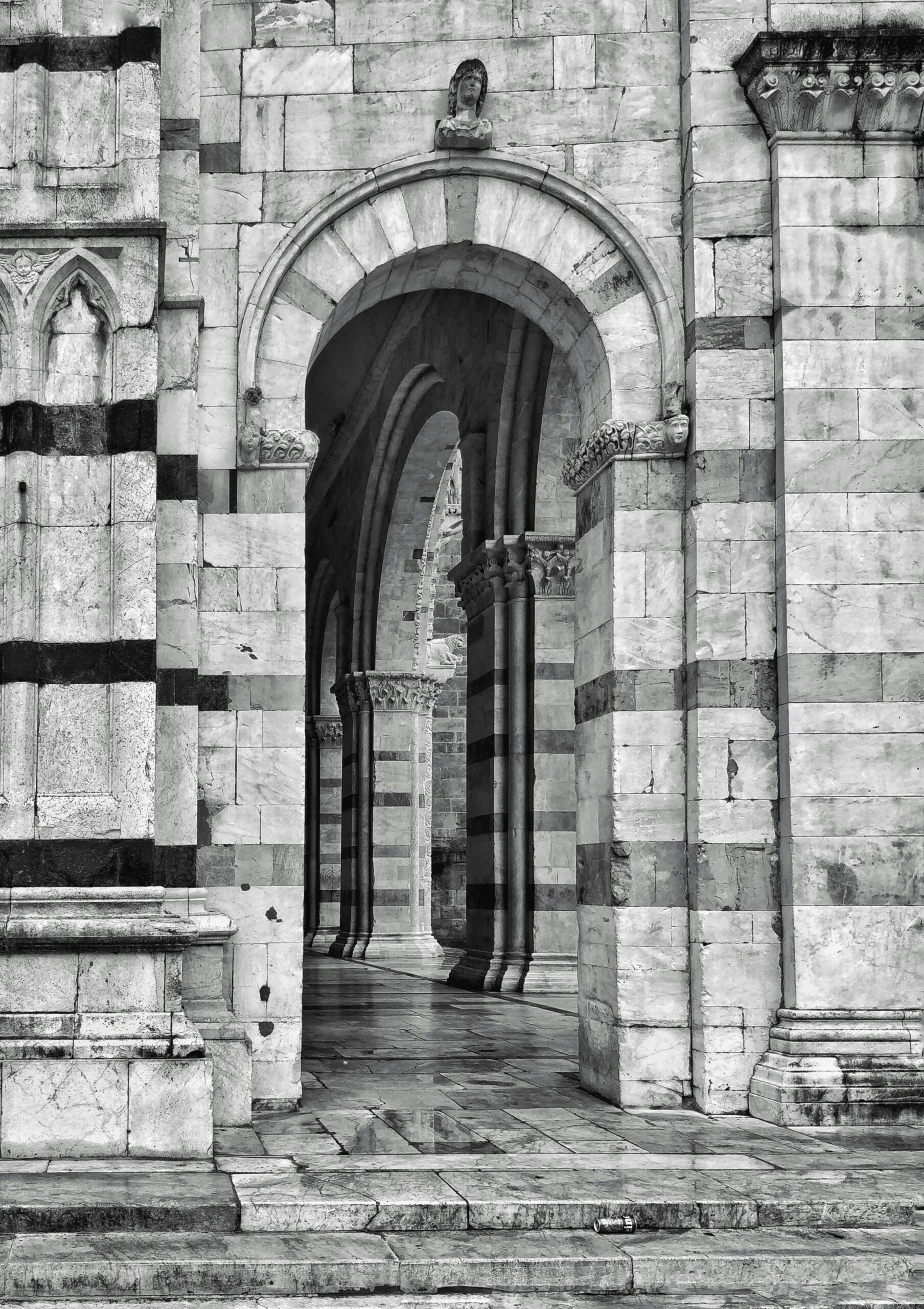
Inside, you will find the Volto Santo (Holy Face), a wooden crucifix that is the true protector of the city. Legend has it that it was carved by Nicodemus and arrived in Lucca on a driverless ship. But before you go in, look at the pillar on the right side of the portico. Carved into the stone is a small labyrinth. It is one of the few surviving symbols of its kind, accompanied by a Latin inscription referencing the myth of Theseus and the Minotaur. It is a pagan symbol on a Catholic cathedral—a fascinating glimpse into the medieval mind where faith and mythology often blurred.
While the other churches favor intricate marble carving, the Basilica of San Frediano goes for bold color. The massive golden mosaic on the facade depicts the Ascension of Christ and glows spectacularly in the morning sun. It is rare to see this Byzantine style so far west in Tuscany.
Inside, things get a little more macabre. In a glass casket, you can see the naturally mummified body of Saint Zita, the patron saint of maids and domestic servants (and arguably, of Lucca itself). She died in 1278, and her body is remarkably well-preserved. Locals still leave flowers for her, especially on her feast day in April. It is a poignant reminder that in Lucca, history isn’t just in books; it is physically present in the room with you.
Lucca is like a lasagna of history (if you will forgive the food metaphor). The medieval city sits on top of the Lombard city, which sits on top of the Roman city. Nowhere is this more evident than at the Church of Saints Giovanni and Reparata.
Located just around the corner from the cathedral, this church offers something the others don’t: a ticket to the underworld. The church itself is beautiful, hosting nightly Puccini concerts that are well worth your time, but the real magic happens when you pay a few euros to descend the metal staircase near the entrance.
Below the current floor, archaeologists have excavated layers of history spanning two thousand years. You can walk through the remains of:
It is a surreal experience to stand in a Roman basement while listening to the muffled sounds of an opera rehearsal happening in the church above you. It connects the dots of Lucca’s timeline in a way that no museum display ever could.
Once you have ticked off the big three and explored the underground, it is time to find the quiet spots. These are the churches where you might be the only visitor, allowing for a moment of genuine silence and reflection.
For years, the massive complex of San Francesco was closed and falling into disrepair. Thanks to a massive restoration project by a local banking foundation, it is now pristine. The church is vast, white, and airy, a stark contrast to the dark, candlelit interiors of the older Romanesque churches. The attached cloisters are now part of a university campus, buzzing with students, which gives the area a lively, youthful energy. Behind the church, the gardens offer a lovely, quiet walking path that feels miles away from the busy Via Fillungo.
The name Forisportam means “outside the gate,” because when this church was built, it was located just outside the original Roman walls (though it is well inside the current Renaissance walls). It is an elegant, unfinished brick structure that feels very authentic.
“Lucca is a city where even the shadows of the churches have stories to tell.”
There is a curious legend involving a “white spider.” It is said that the Virgin Mary performed a miracle here, and if you look closely at the painting of the Assumption inside, you might spot the symbolic reference. It is a quiet church, often overlooked, but it houses distinct artistic treasures and a sun-dial camera obscura on the floor that marks the solar noon.
If you are wandering the northern part of the town, near the Amphitheater, you will spot a bell tower made of brick that glows a soft pink/orange in the sunset. This is San Pietro Somaldi. The facade is typical Lucchese style with its striped marble and blind arcades, but the vibe here is distinctly neighborhood-focused. It feels like a parish church for locals, not a monument for tourists. It is the perfect place to sit on the steps, enjoy a gelato, and watch the world go by.
With one hundred churches, not all of them can still be active places of worship. One of the most interesting aspects of Lucca is how the city has repurposed these sacred spaces without destroying their dignity.
Take the Auditorium del Suffragio, for example. Located right next to the Music Conservatory, this former church is now a stunning concert hall. If you walk by in the late afternoon, you will often hear piano or violin music drifting out into the street. It is a beautiful reminder of Lucca’s musical heritage.
Then there is the church of Santa Caterina, which has found a new life as a uniquely atmospheric space for exhibitions and small markets. Seeing contemporary art or artisan crafts displayed under ancient vaulted ceilings creates a contrast that is quintessentially Italian—the old and the new living in harmony.
If you want to dedicate a morning to the sacred art of Lucca, here is a logical flow that minimizes walking and maximizes awe. This route takes about 3 hours at a leisurely pace.
Before you rush off to explore, a few words of advice to help you blend in with the locals. While Lucca is very welcoming, these are still active places of worship.
Dress appropriately: This is the golden rule in Italy. Shoulders and knees should be covered. In the heat of summer, simply carry a light scarf in your bag that you can throw over your shoulders before entering. It is a sign of respect that goes a long way.
Check the clock: Most churches close for a few hours in the middle of the day (usually from 12:30 PM to 3:00 PM). This is the “pausa,” and you should use it to have lunch. Do not try to force a visit during these hours; the doors will be locked.
Mass times: If a service is in progress, tourists are generally not allowed to wander around taking photos. You can stand quietly at the back, but do not walk up the aisles. Sunday mornings are usually reserved for mass, so plan your sightseeing for the afternoon or a weekday.
Look for the light: Many of these churches were designed centuries before electricity. The architects knew exactly how the sun would move. San Michele is best at sunset; San Frediano is best at sunrise. San Martino has wonderful stained glass that comes alive around 11:00 AM.
Lucca’s churches are more than just piles of stone; they are the storybooks of the city. They hold the myths, the art, and the bones of the people who built this place. So, even if you only step inside two or three of them, take a moment to look past the altar and the pews. Look for the labyrinth, look for the diamond ring, and listen for the echoes of the Roman city beneath your feet.